Showing posts sorted by relevance for query kate forsyth. Sort by date Show all posts
15 March 2013

Review: The Wild Girl by Kate Forsyth

The Wild Girl by Kate Forsyth book cover
* From the author for review *

Last year I read and thoroughly enjoyed Bitter Greens by Australian author Kate Forsyth, giving it five stars. I recently had the pleasure of being contacted directly by the author and invited to read an advanced copy of her latest novel The Wild Girl due to be published on 18 March 2013.

Set in the early 1800s, The Wild Girl is the story of Dortchen Wild, a young girl growing up in the medieval town of Hessen-Cassel in Germany and living next door to the Grimm family.  As most of us know, the brothers Grimm are famous for their collections of fairytales, however it is a little known historical fact that Dortchen Wild told the brothers 1/4 of all of their stories.

Wilhelm and Jakob Grimm make up the brothers Grimm we know today, and Dortchen meets Wilhelm when she's just 12 years old.  The Wild family are incredibly poor and with five sons and one girl (Dortchen's best friend Lotte), several of the brothers continue with their academic and literary pursuits despite their threadbare clothes and empty bellies.

The Wild Girl is based on this true story, and the author Kate Forsyth conducted mountains of research - including reading Wilhelm's diaries - in order to bring Dortchen Wild to life on the page.  It takes place against the backdrop of the Napoleonic wars and I found it fascinating to read about characters experiencing the invasions from this perspective.  For some unknown reason I'd always imagined that the Grimm Fairytales were older than the 1800s, but as the author points out in the novel's Foreword, the young brothers lived in the time of Jane Austen, which was quite a revelation for me.

Portrait of the Brothers Grimm
© Deutsche Märchenstraße e.V.


Dortchen's father owns and operates a shop front and she gathers and prepares the herbs and plants that are used to create the medicines, draughts and tinctures her father sells.  I thoroughly enjoyed this aspect of the novel, and was amazed by Dortchen's knowledge of herbs, tea infusions and medicines for the sick.  

Another favourite part of the novel was the transcribing of stories by the Grimm brothers.  Kate Forsyth was able to vividly portray the image of the brothers eagerly taking notes with quill and ink on parchment as Dortchen (or another person) told them a fairytale or story.  These scenes had a sense of magic, and for a booklover, these segments were a gift.


The Wild Girl is about yearning and love, poverty and sacrifice, but it's also a very dark tale.  Those expecting the same tone as Bitter Greens should prepare themselves for a darker journey, and a greater struggle that lasts almost a lifetime for Dortchen.

Check back soon for a Q&A with author Kate Forsyth, here on Carpe Librum!

My rating = *****

Carpe Librum!
05 July 2022

Review: The Crimson Thread by Kate Forsyth

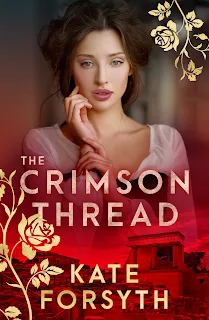
The Crimson Thread by Kate Forsyth book cover

* Copy courtesy of Penguin Random House *

It feels like an abundance of historical fiction set in WWII has been published in the last 5 years and I'm close to reaching my saturation point, but made an immediate exception for one of my favourite Australian authors Kate Forsyth.

The Crimson Thread by Kate Forsyth is an historical fiction novel set during WWII in Crete, an island of Greece. Our protagonist Alenka Klothakis is a local and part of the fierce resistance mounted by the Cretans against the German invasion in 1941. The 11 day Battle of Crete (in which 11,000 soldiers and civilians were killed and injured) was expertly written and I cheered the locals as they attacked and killed as many of the German paratroopers as they could with whatever they had to hand. Alenka offers to help the Allied Forces in a makeshift hospital:
"Alenka soon understood why. She had never seen such pain and suffering before. On every side men held out pleading hands, some weeping. She carried buckets of water in and stinking bedpans out, rolled bandages till her hands ached, scrubbed blood off floors, boiled surgical instruments in one pot and soup in another, and held the hand of one poor young man till he died." Page 96
Australian soldiers Teddy and Jack were compelling characters and their relationship with Alenka and other members of the resistance drove the story forward in a unique way. I think readers will love Jack and while Teddy was much less likeable, his motivations throughout the war were - unfortunately - all too realistic.

This was a five star read but for two quibbles. The first was the way in which the novel began which is both a compliment and a minor quibble. The beginning was so magical and evocative I wanted to stay there. Forever. Instead I was wrenched unwillingly into Alenka's adolescent years and the seemingly sudden beginning of the war. The transition from Alenka's childhood memories straight into the war seemed way too quick for me and out of step with the pace set in the opening few pages. Perhaps I was so keen for another book like Bitter Greens (my all time favourite novel by Kate Forsyth) that my mind raced away in an unrelated direction and I resented leaving Alenka's Yia Yia behind after just meeting her.
"Yia-Yia knew many stories of gods and heroes, giants and nymphs, and the Three Fates who spun and measured and cut the thread of life. Many of Yia-Yia's tales were strange and terrible. A girl who was turned into a tree. A woman cursed with snakes for hair. Another whose tongue was cut out and who could only tell her story by embroidering it upon a cloth. The story Yia-Yia told most often, though, was that of the minotaur in the labyrinth, for it was the mythos of Alenka's home, the ruins of the palace of Knossos in the island of Crete." Page 3
Can you blame me for wanting to read a book of Yia-Yia's telling after that paragraph on the opening page? The second quibble comes towards the end of the novel and I can't mention much without potentially spoiling it for others. Suffice to say, a main character acts completely out of keeping with the circumstances and her choices seemed incredibly simplistic and uncharacteristic after what she had endured during the German occupation.

Now that's off my chest, let me tell you The Crimson Thread is the perfect title for this novel, and I loved the references to embroidery and the thread of fate stitched throughout the pages. The way in which embroidery was used to record and exchange messages, and as a respite from the Nazi occupation was inspiring. I know the author started to embroider in preparation for writing this book and it clearly shows. I love to cross-stitch and picking it up again after an unplanned but lengthy hiatus recently, my heart was warmed any time a stitch was sewn in the book.

The Crimson Thread by Kate Forsyth is highly recommended for fans of historical fiction; even those wary of 'another' WWII novel.

My Rating:


19 July 2019

Review: The Blue Rose by Kate Forsyth

The Blue Rose by Kate Forsyth book cover
* Copy courtesy of Penguin Random House *

It's in Brittany, France in 1788 that we meet our heroine of The Blue Rose by Kate Forsyth. Viviane is the daughter of the Marquis de Ravoisier and she has grown up without a mother at the Chateau de Belisima-sur-le-lac. Viviane is an aristocrat and is thankful her overbearing, gambling father is absent most of the time, living at the court of Versailles.

Viviane is a likeable character and a free spirit, always making herself useful, tending to the sick and injured tenants of her father's land and tramping around the countryside with her three legged dog Luna when she can escape the attentions of her Great Aunt. She doesn't enjoy the privilege her rank provides and would much rather horse about with her milk brother Pierrick.

After a vicious storm, Viviane's father commissions an English gardener David Stronach to construct a beautiful garden at the chateau. With a shared interest in herbs and plants, slowly but surely they begin to fall in love.

Their class divide soon becomes apparent and David is lucky to escape alive when her father returns. He has racked up a considerable gambling debt and Viviane is betrothed to his friend in order to settle the debt. The lovers are separated, Viviane believing David was killed in his escape, David believing Viviane has betrayed him and married for position, title and favour.

The Blue Rose then follows the separate lives of Viviane and David in a period of significant social and political upheaval in France. The French Revolution begins in 1789 and to be an aristo (aristocrat or high born) is a death sentence in some cases.

Meanwhile, David embarks on a British diplomatic journey to Imperial China on an errand on behalf of Sir Joseph Banks.

Throughout their struggles, their love endures and both plights are brought into startling focus in alternate chapters. Covering themes of: love, class, duty, civil war, exploration and the clashing of cultures this is an historical fiction novel you can really sink your teeth into. This is a bloody time in France's history and the author doesn't shy away from the brutality, bloodlust and cruelty of the time.

It's clear from Viviane's experiences that an incredible amount of research has been undertaken by Kate Forsyth. Despite so many bestselling novels, she hasn't written about this period in history before, but you wouldn't know it from the ease from which this tale seemingly emerges.

My only complaint was that the ending seemed a little perfectly timed, but it's a very small criticism in an otherwise evocative and enjoyable historical fiction novel.

The Blue Rose by Australian author Kate Forsyth is recommended reading for historical fiction devotees, romance readers and Francophiles.

Click here to read a FREE extract.

My Rating:

17 November 2024

Review: Psykhe by Kate Forsyth

Psykhe by Kate Forsyth book cover

Having a relatively poor knowledge of Greek and Roman mythology, I was a little concerned when I picked up Psykhe by Kate Forsyth. It's a fictional re-telling of the Greek Godess Psyche and Cupid and I was worried I might end up lost in the narrative or missing references I couldn't place due to my lack of background in the classics.

Kate Forsyth is a favourite Australian author of mine and I should have trusted she would make her tale accessible to those familiar with ancient mythology and those relatively new to it.

Set in Italy, our protagonist introduces herself on the first page by recounting her dramatic birth. Born with the umbilical cord wrapped around her neck and appearing blue and all but dead, her mother's midwife blew air into her lungs and brought her back to life:
"So I was named Psykhe, which means breath and soul and butterfly, words having many meanings. Only gods die and return to this world alive. So as I grew into girlhood, many people began to think I too must be divine." Page 3
It's clear by the second page that Psykhe has albinism and it was interesting to read an historical fiction novel featuring a main character with the physical traits of albinism; white hair, low vision and extremely sensitive skin which can burn and blister in the sun. It's a topic that has interested me for years and you can read my review of Beyond the Pale - Folklore, Family and the Mystery of Our Hidden Genes by Emily Urquhart for more on albinism in history although I suspect there are better books on the topic.

I can't comment on how Psykhe having albinism compares to the original myth, however I did find it a stretch to believe that an albino woman would be considered a great beauty at the time. Usually albinism is accompanied by fears of curses, dark forces or magic.

Psykhe learns the healing properties of herbs and plants and becomes a midwife, also drawing attention to herself as a potential witch. These early years are where the book excels and it's clear the author loves writing about potions and tonics and the many uses for plants known at the time.

Psykhe's relationship with a cruel and absent father highlighted the complete lack of agency she and her sisters experience as young girls and later young women. Psykhe falls in love with an immortal, referred to as Cupid or Eros in ancient mythology and a romance ensues.

When introducing the Vestal Virgins of Rome - which I just learned about watching Those About to Die with Anthony Hopkins - the author describes the Roman temple:
"The round temple to Vesta, where virgins dressed in white tended the everlasting flame of the goddess of the hearth. Taken when only children, they would never know the touch of a man's hand, the deep kiss of desire, the swelling of a child in their womb, the suck of a babe on their breast." Page 103
Readers familiar with Greek and Roman mythology may have issue with some of the author's choices in the novel but I don't know my history well enough to pass judgement. I did find several elements a bit of a stretch (a caesarian section, mouth to mouth resuscitation and the albinism) but largely enjoyed the narrative. While unconvinced by the romance element, I enjoyed the challenges presented by loving a mortal, the supernatural and fantasy elements and the lengths Psykhe goes to for love; including her quest to the underworld.

Psykhe
by Kate Forsyth is a feminist re-telling that will appeal to lovers of mythology, fantasy, romantasy and historical fiction.

My Rating:


20 February 2013

The Wild Girl from Kate Forsyth - Signed!

Signed copy of The Wild Girl
by Kate Forsyth
I was so excited today to receive a parcel containing a signed advance copy of The Wild Girl, the newest offering from Kate Forsyth, author of Bitter Greens.

The Wild Girl is being published in March, and Carpe Librum will be participating in a blog tour as part of the launch, so stay tuned for more details coming soon.

I'm really looking forward to reading this book featuring the Grimm brothers (having enjoyed Bitter Greens so much); and was further enticed by Kate's personal inscription:
For Tracey, 
A story of love, war and fairytales - I hope you are enchanted!
I can't wait to get stuck in and look forward to sharing my review with you all.  

If you have any questions you'd like to ask Kate Forsyth, author of 27 books, please leave a comment below, and I'll make a list for the upcoming blog tour.


Thanks and happy reading!

12 July 2013

Review: Dragonclaw: Book One of the Witches of Eileanan by Kate Forsyth

Dragonclaw: Book One of the Witches of Eileanan by Kate Forsyth book cover
I received my signed copy of Dragonclaw: Book One of the Witches of Eileanan in a competition being run on author Kate Forsyth's website earlier this year.

I absolutely adored her novel Bitter Greens and thoroughly enjoyed The Wild Girl, and so came to Dragonclaw (the author's first published novel) with high expectations.

I knew before turning the first page that Dragonclaw is a YA fantasy novel, however in the very beginning when two witches are discussing the events of the land in front of an open fire, I found I had no idea what they were talking about and even wondered if I'd missed a book.  I felt lost until I realised that the main character is feeling the same way, and the reader isn't supposed to have knowledge of the events being discussed.  It was after this scene that I was able to let myself fall completely into the story.


My signed copy of
Dragonclaw by Kate Forsyth
Dragonclaw is a rich tale full of witches, magic and dragons, and it isn't long before our protagonists are on a significant quest.  There is much backstory to learn and Kate does a great job of drip feeding it into the plot although I was hungry for more.  It was clear midway through the book that their quest would take them beyond book one of this series in much the same way that readers of Eragon realise they're settling in for a great journey a few hundred pages in.

My favourite part of the book were the few scenes with the dragons; I found their characteristics and view of human life fascinating and I hope they appear again later in the series.  In summary, I recommend Dragonclaw to readers who enjoy fantasy novels and quest-driven plots where good and evil must battle for control of the realm.


My rating = ****

Carpe Librum!

The complete series contains the following novels and they all rate above 4 stars on GoodReads:

  • The Witches of Eileanan (The Witches of Eileanan 1) 
  • The Pool of Two Moons (The Witches of Eileanan 2) 
  • The Cursed Towers (The Witches of Eileanan 3) 
  • The Forbidden Land (The Witches of Eileanan 4)
  • The Skull of the World (The Witches of Eileanan 5) 
  • The Fathomless Caves (The Witches of Eileanan 6) 
  • 10 August 2015

    Blog Tour & Review of The Beast's Garden by Kate Forsyth

    * Copy courtesy of the author for review via Penguin Random House Australia and NetGalley *

    Kate Forsyth is one of my favourite Australian authors, and her re-telling of the Rapunzel fairytale in Bitter Greens is still with me, years after reading it.

    The Beast's Garden is Kate Forsyth's latest re-telling and is based on the fairytale Beauty and the Beast. In this case, the beauty is Ava, a talented and beautiful young German woman and the beast of the title is Leo, an intelligent Nazi Officer with an unexpected love of poetry. 


    Set in Nazi Germany during WWII, Ava 
    rejects all of Leo's advances (despite her attraction to him) until the actions of the Gestapo begin to impact those in her immediate circle, including her Jewish friends.

    Taking place in Berlin from 1938 - 1945, we see how regular Germans react to the Gestapo and the Hitler regime, and the impact of war on the city's citizens. Ava takes risks to defy Hitler and joins an underground resistance movement, and sees many of her friends arrested, tortured and killed. Leo works for the Abwehr (secret intelligence service) but Ava isn't quite sure if he's a spy or not and has to tread carefully.

    Ava's childhood friend is sent to Buchenwald concentration camp and the several chapters from his perspective are thoroughly heartbreaking and a haunting reminder of the atrocities committed during the Hitler regime.

    As I was reading this love story filled with brutal destruction, hate and death, (as well as a love of literature) I didn't have the sense of reading a re-telling of Beauty and the Beast in the same way as Bitter Greens. I understand the analogy, but for me The Beast's Garden reads like a WWII historical novel with a fresh perspective. 

    A handful of main characters in the book are fictional, however I've since learned that all events that take place during the novel and many of the people mentioned were based on real figures from history and required years of research.

    The Beast's Garden is bound to appeal to a wide market, those looking for a complex love story and those who want a fresh perspective on the fall of Berlin and the impact of this war on everyday Germans.

    My rating = ***

    For more insight from Kate Forsyth herself about her inspiration for The Beast's Garden, check out her blog post on the topic.
    18 September 2012

    Review: Bitter Greens by Kate Forsyth

    Bitter Greens by Kate Forsyth book cover
    Bitter Greens by Kate Forsyth is essentially the story of Rapunzel, a children's story we all think we know pretty well. However in the hands of Australian author Kate Forsyth - who is currently undertaking a Doctorate in fairytale retellings - the story is told anew and adult readers are in for an absolute treat!

    Early on, we meet Margherita, a young girl living with her parents on their modest income until she is cruelly snatched away by a witch for payment on a promise made by her father a long time ago.

    Charlotte-Rose de la Force is living at court in Versailles, France until she falls out of favour with the Sun King Louis XIV and is sent to a nunnery. Always writing stories, Charlotte-Rose is keen to listen to an old tale from one of the nuns about a young girl sold for a handful of bitter greens.

    La Strega Bella is the witch who locked Rapunzel in the tower and we are given a first person peek at what drove her to those extremes. The reader is taken back to her time as a young girl to find out what drove her towards the dangerous world of dark magic.

    Three lives, three women all interconnected with elements of historical fiction combined with fairytale and magic make for an enchanting and compelling read and I was glued from the first few pages. Even the cover is enticing, and I knew by page 50 that Bitter Greens was going to be a 5 star read for me and I relished every page.

    The novel is on the darker side of fairytale, so don't be expecting shades of Disney or be surprised when the plague comes knocking. Oh, and saucy too! The final third of the novel is quite tantalising - let me tell you - so be prepared ;-)

    Finally, I recommend Bitter Greens to readers who enjoy historical fiction, fairytales and those who enjoy stories with passion, love, hardship, revenge and redemption.

    My rating = *****

    Carpe Librum!

    (P.S. I'm also pleased that Bitter Greens qualifies for both reading challenges).
    02 August 2014

    Review: Dancing on Knives by Kate Forsyth

    * Copy courtesy of The Reading Room, Random House Australia and NetGalley *

    Kate Forsyth is one of my favourite contemporary Australian authors, and I've read and reviewed Bitter Greens (5 stars), The Wild Girl (5 stars) and Dragonclaw: Book One of the Witches of Eileanan (4 stars) over the last few years.  I've even had the pleasure of interviewing Kate on Carpe Librum, you can click here to read the interview.

    Dancing on Knives is her latest novel, published in June 2014 although it's not a re-telling of a fairytale.  Dancing on Knives is set on a run-down coastal farm outside of Narooma in NSW and is the story of a family torn apart by secrets.

    At twenty years of age, Sara is the oldest daughter of the family, and is so haunted by past events she hasn't left the family farm in more than 5 years.

    Dancing on Knives is a rural murder mystery with Sara trying to work out who killed her talented and moody artist father while finding herself in the midst of a budding romance.

    Dancing on Knives is a gritty and dark tale and I really felt the isolation of each of the characters.  The mystery kept me guessing although I wasn't moved by the romance.  It's interesting to note that Kate Forsyth originally wrote this story at the tender age of sixteen and since then, it has undergone several incarnations over the years before being published as Dancing on Knives.  

    It must be said that I didn't enjoy Dancing on Knives as much as her other novels, however it was refreshing to read something entirely different from this author.

    My rating = ***

    Carpe Librum!

    P.S. I loved the reference to Brett Whiteley and his work on page 198 of the novel; he's my favourite Australian artist of all time.
    09 March 2018

    Review: Beauty In Thorns by Kate Forsyth

    Beauty In Thorns is the latest offering by one of my favourite Australian authors Kate Forsyth, renowned for her fairytale re-tellings. I went into this believing Beauty In Thorns was going to be loosely based on the sleeping beauty fairytale. Wrong!

    What I discovered instead was a fascinating look at the lives of a group of successful artists known as the Pre-Raphaelites, which included Dante Gabriel Rossetti, Ned Burne-Jones and William Morris. Yes, William Morris of the medieval inspired wallpaper designs and tapestries. I've long admired his designs so it was a pleasant surprise to find him in this novel.

    Joining the young artists in the mid 1850s, the novel covers the next 50 years of their lives, including their dreams and aspirations, work with various muses, struggles and successes, love and heartbreak and in many cases their physical or mental decline and subsequent death.

    The women in the novel (some beginning as an artist's muse) were equally important to the story and I enjoyed watching their lives unfold within the group as well. Naturally I was most interested in the life, love and work of William Morris and through this book learned that he was an incredibly industrious man. He left an enormous legacy and body of work in all manner of fields, including writing - poetry, essays and translations - textile designs, fabric dyeing, embroidery, stained glass window designs and tonnes more. I think I'm primed to read a book on William Morris next; any suggestions?

    My ultimate wish after reading Beauty In Thorns was that the cover incorporated some kind of reference to the art and poetry that was so very much part of the novel. By the end of the book I understood the reference to sleeping beauty - being one of the major series of paintings by one of the main characters - but to me the novel was about all of the artists and their families. I would much prefer to see one of their paintings on the front than a stylised woman that could be any one of the muses or wives in the novel. I guess I'm saying I have an issue with how this was marketed but the writing and the story was a pleasure to read; even if I did have to put the book down to look up various paintings along the way.

    I highly recommend Beauty of Thorns by Kate Forsyth to fans of historical fiction and anyone with an interest in art and beauty.

    My rating = ****

    Carpe Librum!
    19 March 2013

    Author interview with Kate Forsyth, author of The Wild Girl and Bitter Greens


    It gives me great pleasure to introduce one of Australia's most successful and prolific authors, Kate Forsyth; author of Bitter Greens and her latest release The Wild Girl.

    Kate, thanks for joining us on Carpe Librum.  Let me ask you, with over 25 published books to your name, what do you love most about being a writer?
    Kate Forsyth
    Everything! I love every stage of writing a new novel from buying myself a beautiful new notebook to building the story, step by slow step, to the actual rush of joy that comes when the writing is going well. I would never want to do anything else. 

    Do you plan your novels in advance or does the story unfold as you go?
    Both. I spend quite a long time doing my research, immersing myself in the period, daydreaming, pondering the story, scribbling down ideas, sticking photos and maps into my notebook, exploring possibilities, imagining my characters and the setting and so on. I write an outline, and then draw up a rough plan which normally takes up a page or two in my notebook. I play with ideas for the structure, and establish my keystones - the title, the opening and closing scenes, and a few vividly imagined scenes along the way. I cannot start writing until I have these things firmly in my head, as well as the first line. Once I start to write, the story will unfold in new and unexpected ways, and I really love that part of the process too. 

    I've read that as part of your research for writing The Wild Girl, you read the personal diaries of Wilhelm Grimm, one of the Grimm brothers. What was that experience like and how does one even gain access to such historic papers?
    It was quite amazing, I have to admit. I knew fairly early on that I needed someone in Germany to help with all the research and translations - so many books on the Grimms have never been translated into English. I knew that Dortchen had dictated a memoir to her daughter while on her deathbed, plus there were many other essays and books about the Grimms that I needed help with. I tried for months to find someone to help me but had no luck. One translator I hired was hit by a car, another simply vanished off the face of the earth (or perhaps he simply stopped responding to my emails). 

    The Wild Girl
    One day I was googling in German, looking for any information I could find on the Wild family, when I stumbled upon a blog written by a German artist and cartoonist called Irmgard Peters. She was recounting an old family story about a white cot that had been passed down through generations of her family. In that cot, she said, slept the Wild girls who told the Grimm brothers all their fairy tales. I wrote to her in my execrable German to see if it was at all possible that she meant the Wild girls as in Dortchen, Lisette and Gretchen Wild, and she wrote back (in perfect English) saying yes, she was the direct descendant of Rudolf Wild, their brother, and why did I want to know. When I told her about the novel I was writing, she was very pleased that Dortchen was at last been brought out of the shadows and asked what she could do to help me. 

    She translated Dortchen's memoir (its only a few pages long), and sent me photos of family portraits, and then she corresponded with some of Germany's foremost Grimm scholars on my behalf. Wilhelm's diary had recently been unearthed and one of the scholars was planning to work on it with plans to publish. He told Irmgard and she asked if she might see it and translate it for me, and was given permission. It was so exciting! The diary is not very long and only covers a few years, and Irmgard only translated the pages in which Dortchen is mentioned, but it helped me enormously with the last section of the book. I was unbelievably lucky to have found it! 

    How wonderful to have liaised so closely with a direct descendant of Dortchen's brother, Rudolf. It must have been such an unexpected joy!  That leads into the next question quite well.  I was going to ask if you knew if any descendants of Dortchen Wild have read The Wild Girl?
    I have sent Irmgard a copy of The Wild Girl and am now very anxious in case she hates what I've done. I do hope she likes it!

    I loved reading how Dortchen collected and harvested herbs and plants that she and her father used - in Germany in the early 1800s - to create herbal remedies for sale in the family shop.  How did you conduct the research for this aspect of the novel?
    I have always been interested in herbs and natural healing have a large  library on the subject already. However, most of my books are about English herbs and remedies, and so I needed to find out about German beliefs and practices. A few things helped me. Firstly, I borrowed a book on German apothecaries from the university library and struggled my way through it - the book was incredibly arcane and difficult but taught me a lot about some of the stranger remedies like bezoar stones and the breathing in of mercury fumes to help asthma patients (no wonder Wilhelm was so ill!). It also gave me the recipe for laudanum which was fascinating - I had never realised that the apothecaries bought the opium in its raw state and made up the tincture themselves. 

    Then, when I was in Germany, I visited an apothecary museum which was really illuminating too. Plus, of course, lots and lots of Google Book searches!

    What was the hardest part of writing The Wild Girl?
    The research was difficult and took me a long time. Discovering my story was also hard - so little was known about Dortchen's life and her inner world. I turned to her stories for inspiration and was troubled by the darkness and cruelty in many of the stories, particularly in 'All-Kinds-of-Fur' which is an incest tale. It seemed so strange for a young German woman of Dortchen's time to tell such a story to a young man - and it was so striking the way he later rewrote the story to transform it into a story of escape and healing, rather than imprisonment and pain. And then he called the girl in his version of the story a Wild creature ... like that, with a capital on the W. The more I read, and the more I thought, the clearer it seemed to me that there was darkness and cruelty in Dortchen's own life .... but then I really struggled with my right to imagine a tale like this based on a real woman's unknown life. I talked it over with a number of people I really trust, and decided that this is what we do as fiction writers - we spin stories out of fragments of other stories and other lives. 

    Which part of the book did you write last?
    The last scene. I always write in a linear fashion, from beginning to end, as much as I can.

    One of Kate's fav books
    The White Queen by
    Philippa Gregory
    I've heard that you love to read.  What are some of your favourite books/authors?
    I do love to read! I have so many favourite authors its impossible to list them all, but I'll give it a go. I love: Georgette Heyer, Mary Stewart, Juliet Marillier, Robin McKinley, Philippa Gregory, Joanne Harris, Tracy Chevalier, Kim Wilkins, Kate Morton, Karen Maitland, C.J. Sansom, Geraldine Brooks, Christopher Gortner, Sarah Dunant, Ellis Peters ... check out my website for more.


    Where does your love of history or historical fiction come from?
    I think the books I loved to read as a child - Geoffrey Trease, Rosemary Sutcliff, Jean Plaidy plus many more.


    Do you have any literary influences?
    I think any book I have ever read which I have loved - and so we're talking thousands and thousands of books here! 

    Do you have a favourite bookshop?
    I love any bookshop! I especially love old bookshops with hidden treasures in dusty, cobwebby corners ... ooh, me too; love hidden treasures but hold the spiders!

    What's next?  What are you researching or working on at the moment?
    I'm working on a 5-book children's fantasy adventure, and then I'm planning another historical fairytale retelling - this one set in Nazi Germany.

    What would you like to tell your readers?
    I hope you love my books!

    On that note, thanks so much for joining us today Kate!
    30 December 2018

    Australian Women Writer's Challenge & Aussie Author Challenge Completed in 2018

    It's been a record breaking reading year for me and I've completed all three of my reading challenges. Two of them are Australian, so I thought I'd wrap them both up together here.

    2018 Australian Women Writer's Challenge
    To complete the Franklin level of the 2018 Australian Women Writer's Challenge, I had to read 10 books and review 6 of them. I outdid myself this year and read and reviewed the following 15 books:


    1. Beauty in Thorns by Kate Forsyth
    2. The Suitcase Baby by Tanya Bretherton
    3. The Flying Optometrist by Joanne Anderton
    4. Book of Colours by Robyn Cadwallader
    5. Ache by Eliza Henry-Jones
    6. The Peacock Summer by Hannah Richell
    7. A Superior Spectre by Angela Meyer
    8. The Yellow House by Emily O'Grady
    9. Everywhere I Look by Helen Garner
    10. Always With You by Debbie Malone
    11. The Clockmaker's Daughter by Kate Morton
    12. Paramedic by Sandy Macken
    13. Well Read Cookies by Lauren Chater
    14. Stalked by Rachel Cassidy
    15. The Lost Man by Jane Harper

    Aussie Author Challenge Completed in 2018
    For the Aussie Author Challenge I had to read and review 12 titles by Australian authors across a minimum of 3 genres. At least 4 titles had to be by female authors, 4 titles by male authors and at least 4 had to be new (to me) authors. I smashed the reading challenge this year and read the following 26 books:


    1. The Commando - The Life and Death of Cameron Baird, VC, MG by Ben Mckelvey
    2. Hangman by Jack Heath
    3. Beauty in Thorns by Kate Forsyth
    4. Pentridge: Voices from the Other Side by Rupert Mann
    5. The Suitcase Baby by Tanya Bretherton
    6. The Flying Optometrist by Joanne Anderton
    7. Book of Colours by Robyn Cadwallader
    8. Ache by Eliza Henry-Jones
    9. Cicada by Shaun Tan
    10. The Peacock Summer by Hannah Richell
    11. Australia's Most Unbelievable True Stories by Jim Haynes
    12. A Superior Spectre by Angela Meyer
    13. The Yellow House by Emily O'Grady
    14. Scrublands by Chris Hammer
    15. Best Foot Forward by Adam Hills
    16. The Nowhere Child by Christian White
    17. Everywhere I Look by Helen Garner
    18. Always With You by Debbie Malone
    19. The Clockmaker's Daughter by Kate Morton
    20. Long and Winding Way to the Top by Andrew P Street
    21. Bridge of Clay by Markus Zusak
    22. Paramedic by Sandy Macken
    23. The Girl on the Page by John Purcell
    24. Well Read Cookies by Lauren Chater
    25. Stalked by Rachel Cassidy
    26. The Lost Man by Jane Harper

    What books by Aussie authors did you enjoy this year?

    Carpe Librum!
    31 December 2013

    Completed Aussie Author Challenge 2013

    I had such fun participating in the Aussie Author Challenge 2013 and completed it, exceeding my challenge by 8 books!

    Here's what I read throughout the challenge:


    1.  The Secret Keeper | Kate Morton
    2.  The Internet is a Playground | David Thorne
    3.  Exit Wounds | John Cantwell
    4.  The Devil's in the Detail | Matthew S. Wilson
    5.  Chasing Odysseus | S.D. Gentill
    6.  The Wild Girl | Kate Forsyth
    7.  The Trusted | John M. Green
    8.  The Complete Book of Stumpwork Embroidery | Jane Nicholas
    9.  Get Well Soon! My (Un) Brilliant Career as a Nurse | Kristy Chambers
    10. Betrothed | Wanda Wiltshire
    11. Dragonclaw - The Witches of Eileanan | Kate Forsyth


    Additional books I read for the challenge:
    13. King of the Cross | Mark Dapin
    14. Sweet Damage | Rebecca James
    15. Cloudstreet | Tim Winton
    16. The Melbourne Book - A History Of Now | Maree Coote
    17. Life's A Journey - The Adventure Continues | Ken Duncan
    18. Beauty's Sister | James Bradley
    19. Murder in Mississippi | John Safran
    20. Written On The Skin: An Australian Forensic Casebook | Liz Porter


    I love to support Aussie authors wherever I can, and this is the perfect reading challenge for discovering new and exciting authors, and re-visiting old books as well.

    I've accepted the 2014 Aussie Author Challenge and signed up for another 12 books.  If you want to find out more or join in the fun, just click here.

    Carpe Librum!
    11 April 2025

    Review: The Book of Gothel by Mary McMyne

    The Book of Gothel by Mary McMyne book cover

    In the year 1219, Haelewise is 78 years old and sets down the story of her life and how she became known as Mother Gothel after the tower in which she lives. Famous for allegedly kidnapping Rapunzel, Haelewise tells us her story from childhood into adulthood and old age.

    The book immediately gave me Kate Forsyth Bitter Greens vibes and was on track to be a five star read with descriptions like this setting the scene of 12th Century Germany:
    "I noticed for the first time their brightly dyed kirtles, the stilted way they spoke diutsch. Their long, ribboned braids, which my mother called corpse-braids because they were extended with hair from the dead. They were courtiers' wives." Page 64
    Reading like a fairytale, Haelewise is a compelling character who suffers from light sensitivity and fainting spells. Living with the fear she may be accused of being possessed by a demon if she has a fit in public, I particularly admired her grit and determination after the death of her mother despite an uncaring and barely-there father.

    Having studied under her mother as a midwife, Haelewise travels to an ancient tower to seek out the wise woman who lives there and offer her skills as an apprentice. I would have been happy to follow Haelewise and every step of her apprenticeship as a healer (reminding me of The Binding in many ways) but the author cranks up the story and instead it becomes a quest novel of sorts.

    Essentially a retelling of Rapunzel's story from the witch's perspective, The Book of Gothel has all of the elements of a fairytale; a young girl in trouble; an old wise woman and healer; loss of a parent; an ancient tower; creepy woods; a castle fit for a King; a special horse; spells; dark magic and an evil prince.

    The Book of Gothel by Mary McMyne is recommended for historical fiction readers, Kate Forsyth fans and those who enjoy a good fairytale re-telling.

    My Rating:


    30 December 2019

    Australian Women Writer’s Challenge & Aussie Author Challenge Completed in 2019

    Two reading challenges close to my heart (because they're both Australian and are run by some of my favourite bloggers) are the Australian Women Writer’s Challenge and Aussie Author Challenge. I successfully completed both challenges again this year and thought I'd wrap them up together.

    2019 Australian Women Writer's Challenge

    To complete the Franklin level of the 2019 Australian Women Writer's Challenge I had to read 10 books and review 6 of them. I improved on last year's tally of 15 books and read the following 21 books:
    Australian Women Writer’s Challenge 2019 logo

    1. The Easiest Slow Cooker Book Ever by Kim McCosker ✭✭✭1/2
    2. The Scholar by Dervla McTiernan ✭✭✭
    4. Under the Midnight Sky by Anna Romer ✭✭✭
    5. The Dark Lake by Sarah Bailey ✭✭✭
    6. Small Spaces by Sarah Epstein ✭✭✭✭
    7. Into the Night by Sarah Bailey ✭✭✭
    8. The Accusation by Wendy James ✭✭✭✭1/2
    9. The Forgotten Letters of Esther Durrant by Kayte Nunn ✭✭✭✭
    10. The Museum of Modern Love by Heather Rose ✭✭
    11. Unsolved Australia: Lost Boys, Gone Girls by Justine Ford ✭✭✭
    12. The Blue Rose by Kate Forsyth ✭✭✭✭
    13. Cold Case Investigations by Xanthe Mallett ✭✭✭
    14. Hide by S.J. Morgan ✭✭✭✭
    15. The Van Apfel Girls are Gone by Felicity McLean ✭✭✭
    16. Hive by A.J. Betts ✭✭✭
    17. Rogue by A.J. Betts ✭✭✭
    18. Dressing the Dearloves by Kelly Doust ✭✭✭✭
    19. Death on the Derwent - Sue Neill-Fraser's Story by Robin Bowles ✭✭✭
    20. The Choke by Sofie Laguna ✭✭
    21. The Arsonist by Chloe Hooper ✭✭✭

    Aussie Author 2019 Challenge

    For the Aussie Author 2019 Challenge I had to read and review 12 titles by Australian authors across a minimum of 3 genres. 4 titles had to be by female authors, 4 titles by male authors and at least 4 had to be new (to me) authors. I improved on last year’s number of 26 and read the following 30 books:
    Aussie Author Challenge 2019 logo

    1. Dead Heat by Peter Cotton ✭
    2. Hunter by Jack Heath ✭✭✭✭✭
    3. Green Is The New Black by James Phelps ✭
    4. The Easiest Slow Cooker Book Ever by Kim McCosker ✭✭✭1/2
    5. The Scholar by Dervla McTiernan ✭✭✭
    6. Under the Midnight Sky by Anna Romer ✭✭✭
    7. My Book (Not Yours) by Ben Sanders ✭✭✭
    8. The Dark Lake by Sarah Bailey ✭✭✭
    9. Boxed by Richard Anderson ✭✭✭✭
    10. A Lovely and Terrible Thing by Chris Womersley ✭✭✭
    11. Small Spaces by Sarah Epstein ✭✭✭✭
    12. Into the Night by Sarah Bailey ✭✭✭
    13. The Accusation by Wendy James ✭✭✭✭1/2
    14. The Forgotten Letters of Esther Durrant by Kayte Nunn ✭✭✭✭
    15. The Museum of Modern Love by Heather Rose ✭✭
    16. The Everlasting Sunday by Robert Lukins ✭✭✭
    17. Unsolved Australia: Lost Boys, Gone Girls by Justine Ford ✭✭✭
    18. The Blue Rose by Kate Forsyth ✭✭✭✭
    19. Snake Island by Ben Hobson ✭✭✭✭✭
    20. Cold Case Investigations by Xanthe Mallett ✭✭✭
    21. Silver by Chris Hammer ✭✭✭
    22. Hide by S.J. Morgan ✭✭✭✭
    23. The Van Apfel Girls are Gone by Felicity McLean ✭✭✭
    24. Sh*t Towns of Australia by Rick Furphy and Geoff Rissole ✭
    25. Hive by A.J. Betts ✭✭✭
    26. Rogue by A.J. Betts ✭✭✭
    27. Dressing the Dearloves by Kelly Doust ✭✭✭✭
    28. Death on the Derwent - Sue Neill-Fraser's Story by Robin Bowles ✭✭✭
    29. The Choke by Sofie Laguna ✭✭
    30. The Arsonist by Chloe Hooper ✭✭✭

    As you can see, I had a prolific reading year in 2019 supporting Australian authors and publishers with some fantastic titles in the mix across a variety of genres.

    I'll be signing up for both challenges again in 2020 and sign-up pages are already open so visit the 2020 Australian Women Writer's Challenge and 2020 Aussie Author Challenge pages for more info.

    Carpe Librum!