Long Books
Showing posts with label Long Books. Show all posts
08 August 2025

Review: The Count of Monte Cristo by Alexandre Dumas

The Count of Monte Cristo by Alexandre Dumas Penguin classic book cover

The Count of Monte Cristo by Alexandre Dumas is now the longest book I've ever read, coming in at 1,276 pages. It was definitely the most intimidating book on my TBR and I feel a huge sense of accomplishment having finished it. What can I say about this classic? Well, I enjoyed it more than I thought I would.

Many of you will know the basic outline of the book, Edmond Dantès is falsely imprisoned for a crime he didn't commit. Envious of his success, a number of people collaborate to conspire against him for their own personal gain and when Dantès learns the identity and motivations of his conspirators, he sets out to destroy them.

In order of severity, our conspirators are:

Caderousse - envious neighbour wracked with guilt over the fact he didn't stop the plot
Fernand - in love with Dantès' fiancé Mercédès and guilty of delivering the letter
Danglars - ship's purser and colleague envious of Dantès' recent promotion to ship's captain and responsible for writing the letter accusing him of treason
Villefort - Deputy Crown Prosecutor, sends Dantès to prison without release in order to protect the identity of his Bonapartist father

Later escaping the prison after 14 years and finding a hidden treasure on the island of Monte Cristo thanks to a touching relationship with a fellow prisoner, Dantès completely re-invents himself and becomes an entirely different man. After purchasing the island and founding a chivalric commandership, he leaves his old identity behind and re-enters society as the Count of Monte Cristo.

The descriptions of Dantès' incarceration and meeting with his fellow prisoner Abbé Faria were some of my favourite chapters. Abbé becomes a cherished companion and father figure and eagerly shares his extensive knowledge of languages, science, philosophy, history and politics with Dantès who is transformed by the wisdom generously shared.

During this time we're given access to Dantès thoughts and feelings but after his escape, the reader is no longer privy to his plotting and planning to bring down his enemies. Regrettably we only see the effects of his master plan by joining a range of individual characters including the conspirators and those in their immediate orbit as events transpire.

Here's an example of Villefort reflecting on the fact that he is sacrificing Dantès to his own ambition in order to protect his father:
"Now, in the depths of that sick heart the first seeds of a mortal abscess began to spread." Page 86
Suggesting Villefort will carry remorse in his soul until death is heavy indeed, although later in the book when Dantès catches up with Villefort, he's thriving and far from suffering. In fact, all but Caderousse have succeeded in the time Dantès was imprisoned.

Largely told in a third-person omniscient point of view, when Dantès re-enters society he finds his conspirators much changed:

Caderousse - has lost his livelihood as a tailor and is living in poverty
Fernand - has married Mercédès and is now the Comte de Morcerf after a distinguished service in the military
Danglars - has married into a noble family and is now Baron Danglars, an influential banker in Paris
Villefort - is now Chief Crown Prosecutor, however he's hiding the secret of an illegitimate child

There's a lot of detail and many characters to keep track of. The section in Rome with the bandits went for way too long and really only served to give Dantès an introduction to Parisian society. Sometimes it felt as though we were glimpsing the society goings on purely for the author's entertainment. I did enjoy the witty dialogue between Danglars and Villefort in Paris, but I found myself hoping it was all leading somewhere and part of the bigger plan.

Believing he's God's instrument, Dantès sets out to bring them down one by one:

Caderousse - Dantès gives him a second chance but eventually his greed gets him killed
Fernand (Comte de Morcerf) - Dantès proves Fernand committed treason and he is subsequently disgraced. His wife (Mercédès) and son leave him and he commits suicide from the shame.
Danglars - Dantès manipulates the stockmarket, bankrupting and disgracing Danglars. Fleeing his home in Paris, he steals money to establish a new life in Rome. Kidnapped by bandits (friends of Dantès from earlier in the book), he's imprisoned and starved, forced to buy food and water until he has little money left and is a broken man.
Villefort - Dantès manipulates Villefort's wife (a poisoner) and she poisons several members of Villefort's household. Dantès then exposes Villefort's secret of an illegitimate child in court and Villefort realises his wife is the poisoner. After forcing her to kill herself he suffers a mental breakdown.

Dantès' thirst for revenge seems to wane as the book goes on and there are many insights I enjoyed like this one:
"Truly generous men are always ready to feel compassion when their enemy's misfortune exceeds the bounds of their hatred." Page 953
The author breaks the fourth wall occasionally with phrases like "as we mentioned earlier" or "we owe it to our readers" or "in the previous chapter". And I was surprised when the author referred to himself in Chapter 36: "The author of this story, who lived for five or six years in Italy..." I wasn't expecting to be addressed directly by the author in this manner but readily enjoyed it.

I'll admit Dantès' relationship with the slave girl completely creeped me out. She saw him both as a father figure and a lover - blurgh - so when he ended the novel with her I screwed up my face in distaste. It was fitting that his relationship with Mercédès was beyond repair but what's wrong with sailing into the sunset alone?

Published in 1844, I read the Penguin Classics hardback edition translated by Robin Buss, and when compared to the ebook edition available on Libby, it was a very readable translation. Originally published as a weekly serial in a French newspaper, Dumas was paid by the word (or the line) and the book is understandably quite long as a result.

Enriching this month long reading experience (it took me 33 days, reading 3% each day) was reading The Count of Monte Cristo with fellow book blogger Suzie Eisfelder. Discussing it as we went along, Suzie recorded her thoughts on our buddy read on her YouTube channel where she says: "I thank Tracey for making it possible for me to actually finish this book." You're very welcome Suzie and thanks for sticking with it!

Immediately after finishing, I thought The Count of Monte Cristo by Alexandre Dumas was going to be a five star read. But in the considerable time it's taken for me to write this review - and include all of the character arcs for my own future reference - I'm reconsidering. I'm now able to separate the detailed narrative from the sense of achievement and satisfaction having conquered this sizeable classic and I'm going to settle on 4 stars.

Overall, a very enjoyable buddy read of this classic which I followed up by watching the 1975 version of The Count of Monte Cristo starring Richard Chamberlain.

My Rating:


21 March 2025

Review: The Good Wife of Bath by Karen Brooks

The Good Wife of Bath - A (Mostly) True Story by Karen Brooks book cover

The Good Wife of Bath - A (Mostly) True Story by Karen Brooks is inspired by The Canterbury Tales by Geoffrey Chaucer, but the only thing you need to know about Chaucer's classic written in the late 1300s is that it contains 24 stories told by pilgrims and that The Wife of Bath was one of them.

I read The Canterbury Tales by Geoffrey Chaucer before I started writing reviews here which makes it at least 20 years ago. It felt like quite the accomplishment at the time and I remember enjoying it a whole lot more than I thought I would. Chaucer's The Wife of Bath is the story of a woman named Eleanor who has been married five times and Australian author Karen Brooks brings her to life in this historical fiction re-telling.

It's 1364 and at the age of 12 years old Eleanor is married off to a sheep farmer against her will. I immediately admired Eleanor's young spirit and her attempt to embody her Papa's advice, even at such a young age:
"You have to create opportunities where you can. No matter what life hurls at you, child, catch it. If it's shit, turn it into fertiliser. If it's insults, throw them back. Grip opportunity with both hands and ride it like a wild colt until you've tamed it. You've come from nothing, and unless you make something of yourself with what you're offered, it's to nothing you'll return." Page 22
This advice is applicable to every reader and definitely forms the key to Eleanor's character which serves her well in life.

At 541 pages in length, The Good Wife of Bath is a long novel but it's broken down into each of the five marriages and each time Eleanor marries her life changes significantly; sometimes for the better and sometimes for the worse.

As her circumstances were improving, I was just as giddy with possibility and optimism as Eleanor and equally frustrated and downcast when the wheel of fortune turned. Eleanor takes several pilgrimages and is a flawed character trying to learn from her - many - mistakes while protecting the people she cares about. There's much character growth and some moments that made me stop to contemplate, like this one I hadn't heard before:
"What's good for gander is not for goose to ponder." Page 232
Eleanor is very distantly related - by marriage - to Geoffrey Chaucer and calls him cousin. As a supporting character he pops up from time to time and as he catches up with Eleanor or they exchange letters, we hear about his career highlights and writing projects.

About halfway through the novel, we learn Chaucer has been writing several stories:
"I have. I'm using the idea of a pilgrimage to tie the tales together.' I slapped my thigh in delight. 'I've been on many of those!' 'Aye, and your letters have been most entertaining. Inspirational too. 'Twas you who gave me that idea as well. As you've so often noted, a pilgrimage brings together all manner of people in a shared adventure.'" Page 323
Those who know The Canterbury Tales well will enjoy the flashes of recognition and various easter eggs along the way, but those who aren't familiar with the classic or can't remember it won't experience an absence of understanding or enjoyment; Brooks cleverly includes all readers.

The Good Wife of Bath by Karen Brooks is extremely well researched and the author brings the middle ages to life in a vivid and engaging writing style. While it was a long novel, I would have happily spent more time with Eleanor if I could have.

I thoroughly recommend The Good Wife of Bath by Karen Brooks for historical fiction lovers and it's definitely a solid contender for My Top 5 Books of 2025. Thanks to my friend Andrea for the copy!

My Rating:


17 November 2023

Review: The Armour of Light by Ken Follett

The Armour of Light by Ken Follett book cover

* Copy courtesy of Pan Macmillan *

The Armour of Light by Ken Follett is a 700+ page novel, but if you're concerned it'll be a slow burn or you'll have to suffer through a slow start, fear not. As always, bestselling author Ken Follett drags the reader into the lives of his characters by the scruff of the neck, whether they've made the commitment to invest the requisite time with him or not.

But this is historical fiction I hear you cry, not a thriller. How does he do that? Well, how's this for an opening line?
"Until that day, Sal Clitheroe had never heard her husband scream." Page 3
Okay, I'm in! The opening line introduces us to Sal Clitheroe and we become immediately invested in her plight and that of her husband and family. It's 1792, the focus soon widens and we begin to meet more characters from a range of backgrounds from the town who will go on to tell this story. Some are friends, some are foes and they all have their faults, but together a relatable history of the period begins to form in the reader's mind.

Set in Kingsbridge, England during the Napoleonic Wars, I'll admit to being surprised at the date we pick up the thread again. I wanted to return to the moment soon after the events of The Evening and the Morning and the naming of Kingsbridge which gave me a very pleasant gasp of recognition that left me wanting more.

That said, The Evening and the Morning was actually the prequel to The Pillars of the Earth, however The Armour of Light is the 5th novel in the series and chronologically follows on more than a century after A Column of Fire*.

In The Armour of Light, we return to Kingsbridge 150 (or so) years after those events and during the industrial revolution.* The characters in Kingsbridge are struggling with the introduction of machinery to the local mills, which causes unrest amongst the workers.

Meanwhile, I learned about press gangs for the first time and didn't know that men could be kidnapped or tricked and captured, later waking up on a ship.
"Britain was in constant need of men for the navy. The militia, the home defence force, had no shortage, for it had the power to conscript men whether they liked it or not. There was no conscription into the regular army, but poverty-stricken Ireland supplied about a third of army recruits and the criminal courts accounted for most of the rest... So the biggest problem was the navy, which kept the seas free for British trade." Page 427
"In England, teams called press gangs kidnapped, or 'impressed', able-bodied men in coastal towns, took them aboard ships, and kept them tied up until they were miles from land. The system was hated, and often led to rioting." Page 427
I don't recall this ever coming up in the historical fiction I've read until now, but I could be mistaken. It seems preposterous, doesn't it? That you could drop into your local tavern for a beer and be kidnapped and forced into service, unable to alert your family or provide for them and this plays out in the book.

As in previous work, Follett's depth of research is supported by excellent writing, with the occasional line that made me smile for the sheer joy of it:
"The two men set off again. Willard House was on the market square. The irritatingly officious Sergeant Beach was on duty in the hall, and after a token display of reluctance he showed them in to Donaldson." Page 552
I love the 'token display of reluctance' and seeing this kind of detailed observation on the page is always an unexpected delight. Other than commencing close to two centuries later than I expected, The Armour of Light by Ken Follett delivered on every other hope and expectation. I came to care about the plight and wellbeing of the millworkers and villagers as well as the success of the town, all while understanding that the challenges faced in the industrial revolution were only going to increase.

Follett is able to distil the events of history and make them relatable through the impact to his characters, and I'm now feeling a little more informed about the Napoleonic wars and can't wait to see the release of Napoleon here in Australia later this month.

The Armour of Light by Ken Follett was my most highly anticipated title for 2023 and I can highly recommend it for readers of historical fiction.

* Here's a look at the Kingsbridge series of books in the order you should read them, and the time periods they cover:
Book #0 The Evening and the Morning 997AD - 1007AD
Book #1 The Pillars of the Earth 1135 - 1174
Book #2 World Without End 1327 - 1361
Book #3 A Column of Fire 1558 - 1606
Book #4 The Armour of Light 1792 - 1824

My Rating:


20 December 2021

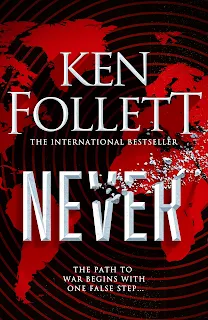
Review: Never by Ken Follett

Never by Ken Follett book cover

* Copy courtesy of Pan Macmillan *

Carpe Librum readers will know I'm a fan of Ken Follett's historical fiction Kingsbridge series which began with The Pillars of the Earth, but the author has also written many successful thrillers across his illustrious writing career. Never is his first contemporary novel in over a decade though, so naturally I was keen to check it out.

Never by Ken Follett is a political thriller about the beginning of World War III and a whopper of a book coming in at 815 pages. In a complex plot that doesn't blame any one country for the escalations, the narrative is populated by various characters located around the world. The actions of these characters inform the plot and the tension slowly builds as each person narrates their role in a much bigger series of events. Major powers are involved and the situation realistically begins to snowball out of control.

Never could be called an espionage thriller or a spy thriller, but it also serves as a timely warning that despite a leader's best intentions, international politics is a dangerous game. In typical Follett style, the author had me looking up new-to-me words throughout the novel, (bellicosity on page 5 and vituperation on page 145)* but not so often as to spoil the rhythm of the book.

I'm not a huge fan of political thrillers, but I always enjoy Ken Follett's deeply layered storytelling and detailed character arcs and put my complete trust in him from page one. Fortunately I was rewarded by the close of this expertly researched - yet very long book - with a surprisingly enjoyable ending. Highly recommended.

* Bellicosity is an inclination to fight or quarrel, a warlike or hostile manner or temperament.
* Vituperation is verbal abuse or language that is full of hate, or angry criticism.

My Rating:


11 January 2021

Top 5 Books of 2020

I had a little difficulty coming up with this list of my favourite books for 2020. In the past I've been proud of the fact that my Top 5 lists have included a combination of review titles, classics and backlist books. This year my shortlist contained only review books. It's not that I didn't read any great 5 star books from my backlist TBR (I'm looking at you Inheritance by Christopher Paolini) but they just didn't make the cut.

Here are my Top 5 Books of 2020 in the order I read them:

1. City of Girls by Elizabeth Gilbert

City of Girls by Elizabeth Gilbert book cover
I've been sharing my Top 5 Books since 2014, but if I'd started a year earlier then The Signature of All Things by Elizabeth Gilbert would definitely have made that list.

City of Girls by Elizabeth Gilbert is about a young woman in 1940s New York who works in a theatre and socialises with glamorous showgirls. I made the assumption this wouldn't be anywhere near as good as The Signature of All Things and went into it expecting an overtly feminine story unlikely to hold my attention. I was so wrong!

In my review, I explain this isn't a romance novel or chick lit. It's not a war novel either. It's a deep exploration of one woman's life, her sexual desire and the inner and outer expectations of those around her. It's a coming-of-age novel about choosing a different path and I enjoyed witnessing Vivian's personal growth and internal realisations and found it incredibly moving in parts.

2. The Foundling by Stacey Halls

The Foundling by Stacey Halls book cover
After the success of The Familiars, the premise and stunning cover design of The Foundling by Stacey Halls drew me in immediately.

Set in London in 1754, Bess Bright makes the heartbreaking decision to leave her illegitimate newborn baby at the Foundling Hospital in London, promising herself she will come back to claim her daughter as soon as she can. Years later, Bess returns only to find her daughter has already been claimed, by her.

This intriguing premise and the unique storytelling style let me know I was in expert hands once again from the very first page. Stacey Halls was able to bring every aspect of Georgian London to life and I greatly enjoyed it.

3. The Rain Heron by Robbie Arnott

The Rain Heron by Robbie Arnott book cover
The opening few chapters of The Rain Heron by Australian author Robbie Arnott were absolutely sublime. I fell in love with the seamless blend of fable and fairytale as I was introduced to the mythical rain heron.

What follows from there is a literary eco-fable, with elements of magical realism in a dystopian setting. There's plenty of tension and some terrific character growth and I felt a real love of nature in both the mountainous and coastal settings featured in the book. There's a clear concern about our environment bubbling along in the background of the story, adding climate-fiction to the number of genres this slim novel falls into.

My reading enjoyment was enhanced even further when my sister read the book and we were able to discuss it. What joy!

4. The Evening and the Morning by Ken Follett

The Evening and the Morning by Ken Follett book cover
This prequel to The Pillars of the Earth was one of my most anticipated releases of 2020 and it didn't disappoint. It came in at a whopping 817 pages and begins in the year 997AD with an introduction to our main character Edgar the Boatbuilder.

Themes of good and evil feature throughout the book and the everyday harsh conditions of farmers, bakers, merchants and priests were expertly written.

Once again my reading enjoyment was enhanced when my Dad began reading his own copy and we were able to discuss the goings on and enjoy the great reveal close to the end of the book.

5. Hideout by Jack Heath

Hideout by Jack Heath book cover
This gritty and bloody crime series featuring a cannibal consultant by the name of Timothy Blake is my favourite Australian crime series, and Hideout was a highly anticipated release in 2020.

Blake is an intelligent, clever and oddly funny anti-hero, and the reader can't help but hope he succeeds in his endeavours, despite knowing about his gruesome proclivities. Blake thinks quick on his feet and is only too aware of his flaws. However, he continues to struggle with his inner demons in the series; wanting to be a better person yet readily identifying with the bad guys.

The unexpected plot developments make this dark and grisly series uniquely refreshing and I can't wait until the next bloody instalment.

Hangman just missed out on my Top 5 list back in 2018, so the inclusion of Hideout on this list does redress that a little.
_________________________________________________________________________________

That's it! What do you think of my list? What was your favourite read in 2020? 


01 October 2020

Review: The Evening and the Morning by Ken Follett

The Evening and the Morning by Ken Follett book cover
* Copy courtesy of Pan Macmillan Australia *

When I heard Ken Follett was writing a prequel to The Pillars of the Earth, I couldn't believe it. The Kingsbridge books are such a terrific and iconic series, I found myself resisting a prequel. I worried that a prequel could dilute the overall quality of the series if it wasn't done well. Even worse, if it was done poorly it could tarnish my view of this epic series. I needn't have worried though. The Evening and the Morning by Ken Follett is a masterpiece of historical fiction and I loved it!

Set in 997AD, I was quickly pulled into the lives of our main characters and became invested in their circumstances. Ken Follett does an incredible job of immersing the reader in the happenings and lives of a household, village or town, making you genuinely care for their individual and collective welfare and prosperity.

Edgar the boatbuilder was an immediate favourite and of course, there are the ever present themes of good versus evil in terms of holy members of the church or righteous merchants and farmers on the one hand and greedy and ambitious men - regardless of their station - grasping for power on the other. 

The harsh conditions of the poor and the everyday lives of farmers, bakers, priests and more enriched my enjoyment as well as my knowledge of the time period and the danger of Viking raids. (Previously informed by shows like The Last Kingdom and Vikings).

The Evening and the Morning contains strong and smart female characters that I loved and loathed in equal measure, whilst admiring the skilful ways in which they navigated the dominance of the men in their lives. Themes of marriage and inheritance were present as were issues of marrying for love, convenience or enhancement.

Coming in at more than 800 pages, I enjoyed the deep characterisation this level of scrutiny allows, throwing up gems like this from page 197:
"And, Edgar reflected, Dreng's parsimony outweighed his malice."
Familiar themes of class and society were explored, although my favourite parts of the novel occurred when hard work and determination finally overcame hardship and steady progress was made. What a simple yet complicated joy!

Being a prequel, clearly this takes place prior to the commencement of the construction of the cathedral, but did so in such a logical and gentle way as to provide a perfect foundation for The Pillars of the Earth. (Pun intended). And when I read the words King's Bridge for the first time, I was deeply moved.

Just as in World Without End and A Column of Fire, The Evening and the Morning can be enjoyed as a standalone, however the reader familiar with the series will gain so much more in the experience.

And while I hardly ever re-read a book, I am now very tempted to revisit The Pillars of the Earth.

With the prequel published this month, the Kingsbridge series by Ken Follett now looks like this:
(Kingsbridge #0) The Evening and the Morning, published 2020
(Kingsbridge #1) The Pillars of the Earth, published 1989
(Kingsbridge #2) World Without End, published 2007
(Kingsbridge #3) A Column of Fire, published 2017

All in all, The Evening and the Morning by Ken Follett was a mighty and engaging read and a worthy addition to the series. Highly recommended!

My Rating:


15 September 2020

Review: To Sleep In A Sea of Stars by Christopher Paolini

To Sleep In A Sea of Stars by Christopher Paolini book cover
* Copy courtesy of Pan Macmillan Australia *

I don't usually like books set in space. As a consequence, I rarely read books set in space. In fact, I can think of only three books set in space that I've thoroughly enjoyed.* So where do I get off picking up an epic science fiction novel set in space that comes in at an impressive 880 pages? What can I say? Christopher Paolini made me do it!

This year I finished the Inheritance Cycle by Christopher Paolini and when I learned To Sleep In A Sea of Stars was Paolini's first novel for adults, I requested an advance copy from the publisher immediately; such is my faith in his writing. I considered that if anyone could lure me into an interstellar battle to save humanity and hold my attention, it was Paolini. Thankfully I was right and I loved this chunkster!

Published today, To Sleep In A Sea of Stars kicks off very quickly with Xenobiologist Kira Navarez conducting a routine survey mission on a planet ahead of a planned colonisation. Kira finds an ancient alien relic and the action doesn't stop from that point on. There is always something happening with the only respite being when the crew are in cryo or recovering from their last skirmish.

I really enjoyed the pace and the character growth, and here's an example from Page 486:
Falconi: "So stop blaming yourself."
Kira: "I can't seem to help it."
Falconi: "Bullshit. The truth is you don't want to. It makes you feel good to blame yourself. You know why?"
Kira shook her head, mute.
Falconi: "Because it gives you a sense of control. The hardest lesson in life is learning to accept that there are some things we can't change."
The history and world building in the novel were very convincing and I enjoyed the introduction of different species and their back stories. My favourite character of the entire book was Itari and I adored the conversations between Kira and Itari. Thinking of them now brings a smile to my face.

Throughout the entire novel I was fully immersed in the world of battleships, cryo tubes, laser blasters, skinsuits, orbital rings, docking hubs and ship minds and I never felt like an impostor.

Travelling FTL (faster than light) didn't phase me, alien technology didn't confuse me and not once did I want to be 'spaced' out of the book. (That's when you're jettisoned out of an air lock to your inevitable death).

Since finishing the book, I've noticed that an enterprising Spotify user has created a playlist to listen to while reading the book. I've been enjoying it this week and it's fantastic. Just search for the book's title on Spotify to find the playlist.

Another thing I enjoyed about To Sleep In A Sea of Stars was the Afterword and Acknowledgements section where Paolini shares with the reader the way in which this novel came to life. The project ups and downs, multiple re-writes and detailed research over the course of many years, gave me an even greater appreciation for the depth and scope of the book, and respect for the author for not rushing it.

To Sleep In A Sea of Stars by Christopher Paolini is a whopping epic science fiction novel bursting with adventure and I loved it! It even gave me pause to re-consider my reading tastes when it comes to science fiction and space operas and you can't ask for more than that.

Highly recommended!

Carpe Librum!
 
My Rating:


* Those books are: The Martian by Andy Weir, The Sparrow by Mary Doria Russell and Red Mars by Kim Stanley Robinson.

Available from Booktopia
28 March 2020

Review: Inheritance by Christopher Paolini

Inheritance by Christopher Paolini book cover
I did it! I finally read Inheritance by Christopher Paolini and in doing so, also achieved the following:

  - Read the book that's been on my bookshelves the longest (9 years, eek!)
  - Participated in the March of the Mammoths read-a-thon for the first time by reading a book longer than 800 pages within the month of March.
  - Finished a series I began back in 2011.

This YA fantasy series began with Eragon, continued with Eldest and Brisingr and concluded with Inheritance. Set in Alagaesia in a world of dragons and dragon riders, magicians, elves, dwarves and epic battles, this series felt a little like Lord of the Rings.

I was thankful for a comprehensive re-cap at the beginning of Inheritance as part of the reason I'd been putting it off was the worry I might not be able to remember what was going on. This concern was quickly allayed and I was plunged straight back into Eragon and Saphira's world. The action was immediate and the conflicts were detailed and gruesome. The dangers and challenges ahead for the characters drew me back into the world of Allagaesia and the fight against the rule of Galbatorix.

At 860 pages in length, Inheritance was a chunkster that took me two weeks straight to get through and definitely qualified for the March of the Mammoths reading challenge. Despite its length, the action was maintained throughout and I was satisfied with the ending of the series.

Inheritance by Christopher Paolini was a highly entertaining read in a genre I don't tend to read often. With my recent enjoyment of this and Strange the Dreamer, perhaps this should change in the future. 

I can highly recommend the Inheritance Cycle series and am of the opinion it stands up well to being read in today's climate.

My Rating:

17 July 2019

Review: The Butterfly Room by Lucinda Riley

The Butterfly Room by Lucinda Riley book cover
* Copy courtesy of Pan Macmillan Australia *

The Butterfly Room by Lucinda Riley is an historical fiction novel told in dual timelines from multiple character perspectives. It's a multi-generational family saga set in Suffolk and contains several mysteries and a few secrets.

Posy Montague is our main character and we meet her at the age of 70 when she is living in the enormous rundown family estate Admiral House, her adult children having moved away.

One of Posy's sons is an antiques dealer and I really enjoyed the little insight we get into his occupation and business.

As we get to know Posy and changes in her family start to happen, we go back in time to Posy's childhood and her father's service in the war. We get a glimpse of Posy's life at university and how she fell in love and eventually married.

The modern timeline features Posy and her children and their various family goings on, which include domestic themes of: friendship, love, parenthood, career, adultery, divorce, domestic violence and grief.

Coming in at more than 600 pages, The Butterfly Room is a very character-driven novel that moves forward inch by inch, conversation by conversation. This person drives to that house, has a conversation. Next day, this person phones that person, travels up from London etc. What kept me engaged throughout the domestic drama were the two mysteries and the hint of a few family secrets that were worth uncovering. (I managed to correctly guess one of them - which never happens - and incorrectly guess the other, so that surprise was satisfying).

After the 400 page mark I started to pick up on a number of repetitions that proved mildly irritating. The repeated use of phrases of endearment like 'my darling girl' and 'my darling boy' were used by different characters way too frequently. While some originated from the same family members - thereby somewhat understandable and thereby excusable - others weren't.

I also noticed that many of the characters had a habit of talking to themselves aloud in full sentences. These sentences were printed with the use of dialogue punctuation which seemed strange and while I can believe one character might do this, I couldn't believe that many characters would possess this personality trait.

When it comes to the title, I'm not quite sure The Butterfly Room was the best title for this generational family saga. A butterfly room does feature in the novel, but it could be perceived as a teaser or a spoiler. I'd have preferred a title capturing the magnificent property that unites all of the characters, that of Admiral House. Riley did a wonderful job of evoking the gardens and property in a way that really made it come to life and was the star of the novel for me.

Recommended for fans of historical fiction, family sagas and romance at all stages of life. Fans of Kate Morton, Hannah Richell, Anna Romer and Sarah Maine will feel at home with Lucinda Riley's The Butterfly Room.

My Rating: