Showing posts sorted by relevance for query Kate Morton. Sort by date Show all posts
14 November 2012

Giveaway: The Secret Keeper by Kate Morton


Here's me with author Kate Morton
I was lucky enough tonight to attend a Dymocks event at the State Library of Victoria tonight where Aussie author Kate Morton was in conversation about her writing process and research process for her new novel The Secret Keeper.

After the interview, Kate took questions from the audience and then graciously took to the foyer to sign books for the bookish fans in a long queue that snaked back into the venue.


Kate Morton signing another fan's book
The Secret Keeper by Kate Morton book coverI was close to the front and after telling Kate she was one of my favourite Aussie authors, she signed two copies of The Secret Keeper for me along with my old favourites: The Forgotten Garden and The Shifting Fog (The Distant Hours having been loaned to a friend of a friend).

Giveaway
Here's the best news: I am giving one of the signed copies of The Secret Keeper away here on Carpe Librum!  This is a proof copy* too which makes it rare and a great keepsake for book-lovers.  

How to Enter
There are 2 ways you can enter:
 - Leave a comment below and tell me which of Kate Morton's books is your favourite, or
- Send an email and tell me what secret you've been keeping.

The giveaway closes on Friday 30th November 2012, good luck everyone!

*The proof copy is courtesy of Allen & Unwin, so many thanks to them.
11 April 2023

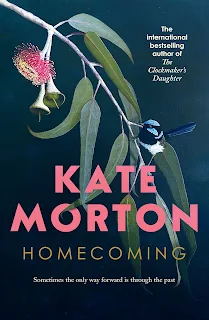
Review: Homecoming by Kate Morton

Homecoming by Kate Morton book cover

* Copy courtesy of Allen & Unwin *


Homecoming by Kate Morton is one of my most highly anticipated releases for 2023. This distinctly Australian historical fiction novel starts strong with a refreshingly different setting - for Morton - on Christmas Eve in 1959. It's here in the Adelaide Hills of South Australia that a terrible tragedy takes place that will reverberate through the Turner family for generations to come.

Meanwhile in the present, Jess returns to Darling House in Sydney after learning her grandmother Nora is in hospital. Jess is estranged from her mother Polly but finds a true crime book at Darling House that covers a family tragedy Jess has never heard of.

Familiar in all of Kate Morton's novels is a sense of connection between the past and present and the haunting of the present by tragic events and people from the past. The author's strength is also in creating homes, manors and mansions with character, and Homecoming had two homes to explore and enjoy.
"You'll see what I mean. It's a house that rewards the curious. Have you explored the nook under the east stairs yet? I used to love playing in there. I dare say it's been lonely all these years, just waiting for a child to claim it as her own." Page 90
Told in a dual narrative style, the nature writing was evocative. I enjoyed mentions of the little township of Hahndorf which reminded me of Devotion by fellow Australian author Hannah Kent set in the same region more than a century earlier. The Australian landscape is wild and beautiful yet also dangerous, as the next excerpt demonstrates:
"The story had given her chills, but of recognition rather than fear. Mythical though the creature might have been, inherent in her children's description was a recognizable truth about this place: the uncomfortable but certain sense that danger, the unknown, was always lurking in the dark spaces 'out there'. This continent was one where beauty and terror were inextricably linked. People died here from thirst if they took a wrong turn. A single spark of fire could grow to consume an entire town. Children who wandered beyond the back fence disappeared into thin air." Page 201
I was reading The Secret Garden by Frances Hodgson Burnett earlier this year, and almost mentioned in my review that I was sure the writing style and infectious appreciation of nature in this classic went on to inspire some of my favourite authors in Kate Forsyth and Kate Morton. This thought bubble didn't make the final edit of the review, however I was reminded of it when I saw this quote very early on in Homecoming by Kate Morton:
"Curious, Percy urged Prince onwards up the dense, wooded slope. He felt like a character in a book. He thought of Mary Lennox as she discovered her secret garden." Page 23
Speaking of curiosities, the very next paragraph had a reference to 'Sir Gawain on the lookout for the Green Knight', a direct reference to a late 14th-century chivalric romance in Middle English, that inspired The Buried Giant by Kazuo Ishiguro that I read just recently. I think it's remarkable how many books reference other works and how authors can inspire others - sometimes from the grave - to create new stories for eager readers.

If you've skipped ahead or noticed the three star rating I'm giving to this novel, you might be wondering why. My primary issue with Homecoming was the use of a book within a book to provide an insight into the 1959 family tragedy. I usually love this writing technique, however in this particular case, the true crime book 'As If They Were Asleep' by Daniel Miller was unconvincing. Excerpts from the book were included in the body of the novel, however the writing style was not that typically found in this genre of non fiction.
"As Nancy had foreshadowed, some of the scenes were written in close third person, as if Daniel Miller had listened to Nora speak about herself and then, rather than write down the interviews precisely as they'd occurred, with his questions followed by her answers, taken the next step of interpreting the memories, history and personal feelings she'd shared, showing the things she'd described. The resulting scenes spoke of many conversations, not just one or two; there were too many diverse details - some of which Jess recognised from Nora's stories, others that were new to her - to have been gleaned in the formal setting of an initial interview." Page 376
This just didn't work for me. The resulting excerpts from Daniel Miller's book read as pure fiction and not a new style of narrative non fiction.
"The scene also showed the intimate way in which Daniel Miller had come to know his 'characters'." Page 346
This writing technique is ineffective if you need to have the character ponder Daniel's writing style within the novel, and then need Daniel Miller's niece to explain how he composed the 'scenes' from his interviews. The resulting effect and mixed tense was confusing and often took me out of the story. The idea of including a true crime element was definitely on trend, but I wished the author had stuck to her tried and true method of revealing secrets and unveiling long held mysteries.

My other gripe was the length of Homecoming. I love a chunky novel and am not deterred by a hefty page count, but at 640 pages in length, this could have been edited down by at least 100 pages. There were moments of terrific writing like this:
"Her grandmother was being very kind to her, which had the effect, as kindness often does, of making Jess feel terribly sad and lonely." Page 90
Wow, so insightful! However, these reading highlights were diluted by the above concerns.

Before I close out this review, I'll leave you with another quote I enjoyed, that provides insight into two siblings arguing:
"Silence fell. A stalemate had seemingly been reached, and with no further shots fired, the room's thick ambience briefly settled. But there is nothing surer than that two siblings, each nursing a problem, will seek refuge in the familiar comforts of quarreling, and so it was with John and Matilda in that moment." Page 309
Homecoming by Kate Morton contains themes of home and belonging, and explores the often rocky relationships between mothers and daughters.

My Rating:


29 October 2015

Review: The Lake House by Kate Morton

* Copy courtesy of Allen & Unwin and The Reading Room *

Kate Morton is one of my favourite Australian authors, and has sold more than 10 million copies of her books, quite an accomplishment. I've enjoyed all of them and The Lake House is her latest standalone historical fiction novel.

In the 1930s, Alice's younger brother Theo disappears during a Midsummer's Eve party at their estate, and is never seen again. The family leave Loeanneth (the lake house of the title) and never return. Alice grows up to become a crime writer, and seventy years later, Detective Sadie Sparrow stumbles across the cold case.

The story unfolds from multiple points of view, as we hear from Sadie, Alice and Alice's mother Eleanor. The result is a rich tapestry of family, regret, guilt, love, grief and the weaving together of secrets to form an intriguing mystery.

The Edevane family house Loeanneth is a character in of itself, magical and bustling with life, and then atmospheric, overgrown and abandoned after the tragic disappearance of little Theo. Morton's description of the house shut up and sealed for decades reminded me of the Paris apartment that lay untouched for 70 years

Morton has clearly had some fun in selecting the character names for The Lake House, Alice from Alice in Wonderland and Peter (Alice's assistant) from Peter Pan are both stories about lost children, and therefore fitting character names for this mystery about a missing child.

Alice was my favourite character by far though, an elderly writer, reclusive, aloof and set in her ways, she was an absolute joy to read.

Living in Australia, the tale of the missing boy is close to my heart, with the unsolved disappearance of William Tyrrell in the news every day and the case of Daniel Morcombe still fresh in my mind. I'll never understand how a person can just 'steal' someone from their lives and loved ones and claim them as their own. In a recent interview, Kate Morton said the disappearance of the Beaumont children had in part inspired her to write a mystery about a missing child.

The past and the present come together beautifully in The Lake House, and my only niggle was that the story was tied up way too neatly at the end in a coincidence that was a little too convenient for this reader to swallow. Some readers will love the reveal, but loyal fans who've read all of Morton's books will recognise that the magic that made me gasp in The Forgotten Garden and The Shifting Fog is absent at the end of The Lake House.

Still highly recommended and I can't wait to read whatever she writes next.

My rating = ****


Carpe Librum!

Watch an interview here with Kate Morton filmed in Cornwall.
02 December 2012

Winner Announced: Secret Keeper Giveaway

Kate has won this autographed copy of The Secret Keeper
by Australian author Kate Morton
The Carpe Librum Secret Keeper Giveaway closed on Friday 30th November and received many entries.

There were two ways to enter, so thanks to those who entered on the blog and shared their favourite book by author Kate Morton and those who submitted their entries via email and shared the secrets they've been keeping.  They made for great reading!

All names were written down on a piece of paper and folded in half, so that the names remained 'secret'.  The folded secrets were then thrown up and the one to land closest to Kate Morton's latest release The Secret Keeper was deemed the winner of this giveaway.

It gives me great pleasure to announce that the winner of the Carpe Librum Secret Keeper Giveaway, and the winner of a proof copy, signed by Kate Morton is...... Kate!  I know it sounds funny, but a follower of the blog by the name of Kate left a comment and her secret name landed right on top of the book, so: 


Congratulations Kate! 

Please email me your postal address, and it will give me great joy to post the autographed book out to you.  Again, thanks to all those who entered, thanks to Allen & Unwin for the proof copy and happy reading.

Carpe Librum!

P.S. It is now 1 February 2013, and Kate is yet to claim her prize and I can't track her down to inform her of her win.  Kate, I do hope you are reading this, please make contact by midnight Friday 8th February 2013, or I'll have to draw another winner.
14 May 2012

Kate Morton's novel The Secret Keeper is coming soon

The Secret Keeper by Kate Morton book coverIt's no secret that author Kate Morton is one of my favourite Australian authors. Her novel The Forgotten Garden (5 stars) is one of my Top 20 favourite novels and I also enjoyed reading The Distant Hours (5 stars) and The Shifting Fog (4 stars).

The Secret Keeper by Kate Morton book coverWell, I'm very excited about Kate Morton's latest book The Secret Keeper, due to be published later in the year.  

Until now, the cover designs for The Secret Keeper have been a well kept secret, but they've just been released so I thought I'd share them on My Four Bucks.

Which cover design do you like the most? I prefer the green and blue design best, but that's just me. I can't wait to read The Secret Keeper when it's published in October 2012. Will you be adding it to you your TBR pile too?

Carpe Librum!
19 February 2015

Review: The Girl in the Photograph by Kate Riordan

* Copy courtesy of NetGalley for review *

The Girl in the Photograph is an atmospheric historical fiction novel by Kate Riordan that captured my interest from the very beginning.

Set in Fiercombe manor, this is the story of two women, Elizabeth in the 1890s and Alice in the 1930s and we hear from both women in the first person.

When Alice moves to Fiercombe Manor, she becomes interested and perhaps even obsessed with the life of Elizabeth, previous lady of the house. Alice starts to unravel Elizabeth's story, and discovers it's not too different from her own.

Both women feel oppressed by the social standards and expectations of the time in which they live; Alice by her mother and Elizabeth by her husband, giving the novel an almost gothic atmosphere.

Early comparisons to Kate Morton seem to follow every review of The Girl in the Photograph, and I have to agree. I'm a devoted fan of Australian author Kate Morton, and although Kate Riordan is a UK writer, The Girl in the Photograph, definitely feels as though it could have been written by Morton. The way in which Riordan splits her story into two time periods, with the character in the present (in this case the 1930s) pulling at threads of the past and feeling that the ghost of time and the essence of Elizabeth is never too far away is strongly reminiscent of Kate Morton's style.

Far from being critical of the similarities in style, I feel I've discovered a new favourite author to add to my list and I eagerly anticipate the next offering from Kate Riordan.

My rating = ****

Carpe Librum!

P.S. If you're into combining music with your reading, then I suggest listening to Johnny Belinda or Hanging On by Active Child when reading this novel. They seem to go hand in hand.
29 January 2011

Review: The Distant Hours by Kate Morton

The Distant Hours by Kate Morton book coverAfter declaring Kate Morton's novel The Forgotten Garden my favourite book of 2010, and telling anyone who will listen, I've been hanging out to read her latest book The Distant Hours.

Edie is a book publisher and is curious when her mother receives a long lost letter, originally posted in 1941 from Milderhurst Castle. Her mother is secretive about her past, but Edie soon finds out she was billeted at the castle for a short time during the war.

Edie is inexplicably drawn to the castle and meets the three elderly Blythe sisters without revealing her mother's connection. Twins Percy and Saffy live together with their younger sister Juniper in the slowly decaying castle. The reasons they each chose to stay at the castle after the war and why they never married or had children have been deeply buried in the past.

As Edie tries to peel back the layers of the past, the reader is whisked back to 1940s war time and thrust into the lives of the Blythe sisters. We find that each of the sisters have their own dreams and aspirations and we discover what transpired to bond the sisters together for life.

I reveled in the fact that the characters loved to read, write and tell stories, and all shared a love of books. The reference to the library in the castle made me weak at the knees, as did the news of what happened there for that matter! There is even reference to a children's book written by one of the characters called The True History of the Mud Man, which becomes pivotal to the story.

The pages are rich with the sense of unravelling mysteries and long kept secrets, and Milderhurst Castle itself is a haunting and gothic presence for each of the characters. These themes can also be found in her other novels, The Forgotten Garden and The Shifting Fog, and is the main reason Kate Morton is my favourite Australian author.

In her own words, Kate says:

"This novel brings together many of my favourite things. A crumbling castle, a family of sisters, a love of books and reading, the haunting of the present by the past, thwarted love, ghostly shivers, mystery and memory and secrets".

This pretty much sums up everything I love about her books, and this one is no exception. As long as these are the themes she likes to explore, I'll continue to enjoy exploring them with her as the reader.

I highly recommend this book and it's going to be a hard one to beat in 2011.

My rating = *****

Carpe Librum!
12 September 2018

Review: The Clockmaker's Daughter by Kate Morton

RRP $32.99 AUD
Published 12 September 2018
* Copy courtesy of Allen & Unwin *

The Clockmaker's Daughter is the hotly anticipated historical fiction novel from Kate Morton published today. Told from multiple character view points and unfolding across several time periods, this was quite an ambitious and unexpectedly complex novel.

Despite the magical and evocative writing style that I love, the novel contained more than 20 main characters and I often found it tough to keep all of the characters - and their relationships to each other - straight in my mind. Added to that, the narrative jumped forwards and backwards in time from the point of view of multiple characters and I often felt the story was disjointed as a result.

I enjoyed the writing and setting more than the overarching storyline and would have preferred a tightening up of the novel to make it easier for the average reader to follow. Chapter headings telling us who was narrating would have been a terrific start, although there was a certain mystique to the voice of Birdie. 


At 582 pages, The Clockmaker's Daughter is a hefty read and I definitely recommend reading it monogamously with as few breaks as possible. I always read multiple books simultaneously, and just one or two days between reading sessions in this case meant that I easily lost track of which narrator I was with and where I was in the timeframe.

Having said all of that, the mystery in
The Clockmaker's Daughter was marvellous and I'll never tire of Kate Morton's writing style. Her novels always contain secrets, the mysteries of time and the effect lives lived have on a place. My favourite character was in fact Birchwood Manor on the river Thames. It was described so well and formed the perfect anchor in the story to unite the characters.

If this were any other author, I'd be giving this novel 3 stars or below, but I have to admit the sheer joy of holding a chunky new novel by one of my favourite Australian authors in Kate Morton significantly added to my reading enjoyment and made up for the moments I felt lost in her web of stories.

My rating = ***1/2

Carpe Librum!
25 January 2013

Review: The Secret Keeper by Kate Morton

Autographed copy
Background
I've been waiting to read The Secret Keeper by Kate Morton for such a long time.  I wrote about it in May 2012 when her cover design was being released, and even had the chance to meet Kate Morton in person on 14 November 2012 where she signed my proof copy of The Secret Keeper given to me courtesy of Allen & Unwin (pictured left).

Until then, I've been savouring this delicious tome, trying to prolong the moment when I immersed myself in its pages.  Alas in January 2013 I could wait no longer.


The Review
I tumbled into the tale of The Secret Keeper easily, as I met the young Laurel just starting out her life, and the mature Laurel decades later, preparing to lose her mother to a terminal illness and suddenly wanting to know more about her life and the violent act she witnessed as a young girl. 


This is my favourite excerpt from the novel; Laurel is at the Bodleian Library and is asking Ben to look at one of the alumni collections:
"It's up a spiral staircase, you know, accessed through a door hidden in the panelling in the Hall. Like something out of Hogwarts." 
Laurel had read Harry Potter, of course, and was no less immune to the charms of old buildings than anyone else; but opening hours were limited . . . [ it ] left her rather panicked at the thought of spending another minute discussing either architecture or fiction with Ben.  She smiled with a dazed lack of comprehension (Hogwarts?), he met it with one of sympathetic realisation (muggle), and they both moved on.
All in all, Kate Morton remains one of my favourite Australian authors, and The Secret Keeper has it all: a great love story during WWII London, mystery, murder and in summary an enchanting historical fiction novel.

My rating = ****

Carpe Librum!
31 December 2010

Review: The Shifting Fog by Kate Morton

The Shifting Fog by Kate Morton book coverAfter reading Kate Morton's sensational novel The Forgotten Garden - and giving it 5 stars - I couldn't wait to sink my teeth into The Shifting Fog, also known (and printed in other countries) as The House at Riverton.

In the beginning of the novel, the reader is aware that there is going to be a shooting at the lake at Riverton Manor and a famous young poet will die - presumably by suicide - but we're not quite sure why. We meet Grace, who was employed as a servant at Riverton Manor at the young age of 14 and was ensconced in the household during this period. When Grace is in her late 90's and living in a nursing home, she is contacted by a film maker looking to make a film of the events leading up to the suicide. The film maker has researched the characters and the period, and asks Grace for her input to ensure the sets are an accurate portrayal of the manor during the roaring 1920's.

Grace begins to reflect on her time at the manor; observing sisters Hannah and Emmeline and the secrets she has protected since then. We are taken back to the period in long vivid flashbacks, and become immersed in the house and entranced by the characters. The book is very gothic in its setting and rich in secrets, long kept loyalties and a sense of tradition. We also witness the slow decline of Riverton Manor and the changing social landscape following World War I and the devastation that came with it.

Grace reveals the truth about the young poet's death at the end of the book, and for me it came as a complete surprise and I'd go so far as to say it was even haunting. As a result, we learn why sisters Hannah and Emmeline never spoke to each other again after that night.

Kate Morton has used a similar plot design as she did in The Forgotten Garden - two different time periods, characters haunted by the past, family drama, mystery and secrets slowly revealed - however it's such a magical and effective concoction and I enjoyed it very much. I have to say I preferred The Forgotten Garden, however the suspense and mystery in this novel had me completely gripped. I would highly recommend The Shifting Fog to other readers.

My rating = ****

Carpe Librum!
28 March 2010

Review: The Forgotten Garden by Kate Morton

The Forgotten Garden by Kate Morton book coverI absolutely loved this book and was hooked from the very beginning. In 1913 a four year old girl is told to hide on the deck of a ship bound from London to Australia. When she arrives in Australia she finds herself all alone, forming the beginning of a book rich in Victorian mystery and intrigue. The book switches back and forth in time to pick up each of the family threads leading to this point and to the present day with the granddaughter of the little girl seeking her own answers to her ancestry.

I thoroughly enjoyed the twists and turns through the family history and the secrets revealed along the way. The suspense was maintained throughout the book and each time a new secret or piece of the puzzle came to life, I just wanted more! I loved the authoress and her fairytales, the mansion, the maze, the brooch and of course the 'secret garden'.

This book came highly recommended, and I'm so proud in the knowledge Kate Morton is an Australian author. This is a terrific piece of writing.

Highly recommended.

My rating = *****

Carpe Librum!
30 December 2018

Australian Women Writer's Challenge & Aussie Author Challenge Completed in 2018

It's been a record breaking reading year for me and I've completed all three of my reading challenges. Two of them are Australian, so I thought I'd wrap them both up together here.

2018 Australian Women Writer's Challenge
To complete the Franklin level of the 2018 Australian Women Writer's Challenge, I had to read 10 books and review 6 of them. I outdid myself this year and read and reviewed the following 15 books:


1. Beauty in Thorns by Kate Forsyth
2. The Suitcase Baby by Tanya Bretherton
3. The Flying Optometrist by Joanne Anderton
4. Book of Colours by Robyn Cadwallader
5. Ache by Eliza Henry-Jones
6. The Peacock Summer by Hannah Richell
7. A Superior Spectre by Angela Meyer
8. The Yellow House by Emily O'Grady
9. Everywhere I Look by Helen Garner
10. Always With You by Debbie Malone
11. The Clockmaker's Daughter by Kate Morton
12. Paramedic by Sandy Macken
13. Well Read Cookies by Lauren Chater
14. Stalked by Rachel Cassidy
15. The Lost Man by Jane Harper

Aussie Author Challenge Completed in 2018
For the Aussie Author Challenge I had to read and review 12 titles by Australian authors across a minimum of 3 genres. At least 4 titles had to be by female authors, 4 titles by male authors and at least 4 had to be new (to me) authors. I smashed the reading challenge this year and read the following 26 books:


1. The Commando - The Life and Death of Cameron Baird, VC, MG by Ben Mckelvey
2. Hangman by Jack Heath
3. Beauty in Thorns by Kate Forsyth
4. Pentridge: Voices from the Other Side by Rupert Mann
5. The Suitcase Baby by Tanya Bretherton
6. The Flying Optometrist by Joanne Anderton
7. Book of Colours by Robyn Cadwallader
8. Ache by Eliza Henry-Jones
9. Cicada by Shaun Tan
10. The Peacock Summer by Hannah Richell
11. Australia's Most Unbelievable True Stories by Jim Haynes
12. A Superior Spectre by Angela Meyer
13. The Yellow House by Emily O'Grady
14. Scrublands by Chris Hammer
15. Best Foot Forward by Adam Hills
16. The Nowhere Child by Christian White
17. Everywhere I Look by Helen Garner
18. Always With You by Debbie Malone
19. The Clockmaker's Daughter by Kate Morton
20. Long and Winding Way to the Top by Andrew P Street
21. Bridge of Clay by Markus Zusak
22. Paramedic by Sandy Macken
23. The Girl on the Page by John Purcell
24. Well Read Cookies by Lauren Chater
25. Stalked by Rachel Cassidy
26. The Lost Man by Jane Harper

What books by Aussie authors did you enjoy this year?

Carpe Librum!
17 January 2020

My Top 10 Books of the Decade (2010 - 2019)

This list is my own personal top 10 favourite books of the decade. This list has been drawn from the books I've read during the last ten years, and isn't a list of the best published books of the decade. Each book chosen has stood the test of time in my own personal reading experience. Some were new releases, some were backlist and some were published decades (or in one case more than 100 years) ago.

Here are my Top 10 Books of the Decade (2010 - 2019) in the order I read them:

The Forgotten Garden by Kate Morton book cover

The Forgotten Garden by Kate Morton

A dual narrative historical fiction novel about a 4yo girl abandoned on a ship bound for Australia in 1913.

Three Men In A Boat by Jerome K Jerome

Published in 1889, this Penguin Classic is about a trip up the Thames river by three men and is an absolute hoot.

Bitter Greens by Kate Forsyth

An historical fiction fairytale retelling of Rapunzel full of passion, love, hardship, revenge and redemption.

Cloudstreet by Tim Winton

A uniquely Australian novel about two families. Incredibly memorable and moving.

The Martian by Andy Weir

I don't read much science fiction but this was MacGyver in space with an awesome sense of humour.

Stoner by John Williams

A deeply honest portrait of an average man told with such care and beauty that the ending brought a tear to my eye.

The Four Tendencies by Gretchen Rubin

The only non fiction book of the list, I learned a lot about myself and others in this book and still think about it every few days.

The Corset by Laura Purcell

A Victorian gothic thriller about secrets, friendship, needlework, gruesome hardship, betrayal, revenge, redemption, hope, poison and mystery with an ending that made me gasp.

The Binding by Bridget Collins book cover

The Binding by Bridget Collins

A combination of fantasy and historical fiction about the art of binding memories into a book.

Strange the Dreamer by Laini Taylor

A young adult fantasy novel about a boy who grows up in a library and is obsessed by the mysteries surrounding the lost city of Weep.

Thoughts?

Wow, what an eclectic list! What are your thoughts? It was great to see three Australian authors on the list and a good combination of genres represented. 

An honourable mention should go to one of my favourite authors Philippa Gregory. Two of her books were included on my Top 5 books of 2015 and 2016 respectively, but she just missed out on making it onto my Top 10 Books of the Decade. 

Have you read any of the books on my Top 10 list?

Carpe Librum!

01 February 2013

Seeking Kate - Winner of The Secret Keeper Giveaway

In November 2012, I ran a giveaway to win a signed copy of Kate Morton's novel The Secret Keeper.  The winner was announced on 2 December 2012, and lucky Carpe Librum entrant Kate was declared the winner.


Kate, you have one more week to claim
The Secret Keeper Giveaway!!


Prize to be claimed by Kate
Since then, I haven't been able to contact Kate, and I'm desperate to unite her with her prize, so if you're reading this Kate, please make contact by midnight Friday 8th February 2013.

If I can't make contact by that date, I'll have no other choice but to draw a new winner from the other entrants in the competition.

Carpe Librum!
07 May 2015

Book cover and blurb announced for The Lake House, new novel by Kate Morton

I'm a huge fan of bestselling Australian author Kate Morton, and I'm so excited today because Allen & Unwin have just sent out a media release containing the blurb and Australian front cover for her new novel The Lake House.

Blurb
An abandoned house... After a particularly troubling case, Sadie Sparrow is sent on an enforced break from her job with the Metropolitan Police and retreats to her beloved grandfather’s cottage in Cornwall. There she finds herself at a loose end, until one day she stumbles upon an abandoned house surrounded by overgrown gardens and dense woods, and learns the story of a baby boy who disappeared without a trace.

A missing child... June 1933, and the Edevane family’s country house, Loeanneth, is polished and gleaming, ready for the much-anticipated Midsummer Eve party. For Eleanor, the annual party has always been one of her treasured traditions, but her middle daughter, Alice, sixteen years old and with literary ambitions, is especially excited. Not only has Alice worked out the perfect twist for her novel, she’s also fallen helplessly in love with someone she shouldn’t. But by the time midnight strikes and fireworks light up the night sky, the Edevane family will have suffered a loss so great they leave Loeanneth and never return.


An unsolved mystery... Seventy years later, in the attic writing room of her elegant Hampstead home, the formidable Alice Edevane leads a life as neatly plotted as the bestselling detective novels she writes. Until a young police detective starts asking questions about her family’s past and seeking to resurrect the complex tangle of secrets Alice has spent her life trying to escape...

The Lake House will be released here in Australia on 31 October 2015 and I can't wait to read it!

It's an exciting day here at Carpe Librum!
05 June 2019

Review: The Forgotten Letters of Esther Durrant by Kayte Nunn

The Forgotten Letters of Esther Durrant by Kayte Nunn book cover
* Copy courtesy of Hachette Australia *

The Forgotten Letters of Esther Durrant is a terrific historical fiction novel from Australian author Kayte Nunn. Unfolding in dual timelines (1950s and 2018), the story is told from three character perspectives: Rachel (Marine Scientist), Esther Durrant (of the title) and Eve, looking after her grandmother in London.

It has to be said that I'm not usually a fan of romance novels or a great love story, but somehow Kayte Nunn tricked me by writing such a compelling historical fiction novel about a woman committed to a mental asylum by her husband in the 1950s, that the romance elements kind of snuck up on me.

Esther Durrant is a young mother committed to a private hospice by her husband with the very best of intentions for her care and recovery. It's 1951 and Esther is outraged when she finds herself trapped at Little Embers, which seems to be little more than a mental asylum. She has no choice but to surrender to the treatment being offered to her and the other patients in residence; men suffering shell shock and PTSD from the war.


Rachel takes up her new research post in the Isles of Scilly, off the Cornish coast and soon comes across the isolated island location of Little Embers. It's there that she discovers a number of incredibly moving letters secreted away in an old suitcase. (Although by the end of the novel, there's never an explanation for why the suitcase wasn't 'sent on' as planned).

In London, Eve is taking care of her grandmother - a retired mountaineer - and helping to write her memoir. These three storylines intertwined exceptionally well with just the right amount of time spent with each character.

The location was vividly described and I enjoyed the remote locality and the rugged wilderness of the Isles of Scilly in both timelines. However I'm not convinced the cover accurately conveyed the content or feel of the novel for me. Perhaps an image of the mental asylum on a remote island with a pair of hiking boots next to the door step would have encompassed the feel of the novel better for me. I also have no idea why there’s a butterfly on the cover.

The promo for this novel promises it will appeal to readers who love Elizabeth Gilbert and Kate Morton. I heartily agree with this. However, I'd go one step further to say that Kayte Nunn achieves her story in a far more compact and precise way than Elizabeth Gilbert did in The Signature of All Things and managed the timelines far better than Kate Morton did in her last novel The Clockmaker's Daughter.


The Forgotten Letters of Esther Durrant is highly recommended for historical fiction fans; even those who don't typically enjoy a romance.

My rating = ****

Carpe Librum!
19 March 2013

Author interview with Kate Forsyth, author of The Wild Girl and Bitter Greens


It gives me great pleasure to introduce one of Australia's most successful and prolific authors, Kate Forsyth; author of Bitter Greens and her latest release The Wild Girl.

Kate, thanks for joining us on Carpe Librum.  Let me ask you, with over 25 published books to your name, what do you love most about being a writer?
Kate Forsyth
Everything! I love every stage of writing a new novel from buying myself a beautiful new notebook to building the story, step by slow step, to the actual rush of joy that comes when the writing is going well. I would never want to do anything else. 

Do you plan your novels in advance or does the story unfold as you go?
Both. I spend quite a long time doing my research, immersing myself in the period, daydreaming, pondering the story, scribbling down ideas, sticking photos and maps into my notebook, exploring possibilities, imagining my characters and the setting and so on. I write an outline, and then draw up a rough plan which normally takes up a page or two in my notebook. I play with ideas for the structure, and establish my keystones - the title, the opening and closing scenes, and a few vividly imagined scenes along the way. I cannot start writing until I have these things firmly in my head, as well as the first line. Once I start to write, the story will unfold in new and unexpected ways, and I really love that part of the process too. 

I've read that as part of your research for writing The Wild Girl, you read the personal diaries of Wilhelm Grimm, one of the Grimm brothers. What was that experience like and how does one even gain access to such historic papers?
It was quite amazing, I have to admit. I knew fairly early on that I needed someone in Germany to help with all the research and translations - so many books on the Grimms have never been translated into English. I knew that Dortchen had dictated a memoir to her daughter while on her deathbed, plus there were many other essays and books about the Grimms that I needed help with. I tried for months to find someone to help me but had no luck. One translator I hired was hit by a car, another simply vanished off the face of the earth (or perhaps he simply stopped responding to my emails). 

The Wild Girl
One day I was googling in German, looking for any information I could find on the Wild family, when I stumbled upon a blog written by a German artist and cartoonist called Irmgard Peters. She was recounting an old family story about a white cot that had been passed down through generations of her family. In that cot, she said, slept the Wild girls who told the Grimm brothers all their fairy tales. I wrote to her in my execrable German to see if it was at all possible that she meant the Wild girls as in Dortchen, Lisette and Gretchen Wild, and she wrote back (in perfect English) saying yes, she was the direct descendant of Rudolf Wild, their brother, and why did I want to know. When I told her about the novel I was writing, she was very pleased that Dortchen was at last been brought out of the shadows and asked what she could do to help me. 

She translated Dortchen's memoir (its only a few pages long), and sent me photos of family portraits, and then she corresponded with some of Germany's foremost Grimm scholars on my behalf. Wilhelm's diary had recently been unearthed and one of the scholars was planning to work on it with plans to publish. He told Irmgard and she asked if she might see it and translate it for me, and was given permission. It was so exciting! The diary is not very long and only covers a few years, and Irmgard only translated the pages in which Dortchen is mentioned, but it helped me enormously with the last section of the book. I was unbelievably lucky to have found it! 

How wonderful to have liaised so closely with a direct descendant of Dortchen's brother, Rudolf. It must have been such an unexpected joy!  That leads into the next question quite well.  I was going to ask if you knew if any descendants of Dortchen Wild have read The Wild Girl?
I have sent Irmgard a copy of The Wild Girl and am now very anxious in case she hates what I've done. I do hope she likes it!

I loved reading how Dortchen collected and harvested herbs and plants that she and her father used - in Germany in the early 1800s - to create herbal remedies for sale in the family shop.  How did you conduct the research for this aspect of the novel?
I have always been interested in herbs and natural healing have a large  library on the subject already. However, most of my books are about English herbs and remedies, and so I needed to find out about German beliefs and practices. A few things helped me. Firstly, I borrowed a book on German apothecaries from the university library and struggled my way through it - the book was incredibly arcane and difficult but taught me a lot about some of the stranger remedies like bezoar stones and the breathing in of mercury fumes to help asthma patients (no wonder Wilhelm was so ill!). It also gave me the recipe for laudanum which was fascinating - I had never realised that the apothecaries bought the opium in its raw state and made up the tincture themselves. 

Then, when I was in Germany, I visited an apothecary museum which was really illuminating too. Plus, of course, lots and lots of Google Book searches!

What was the hardest part of writing The Wild Girl?
The research was difficult and took me a long time. Discovering my story was also hard - so little was known about Dortchen's life and her inner world. I turned to her stories for inspiration and was troubled by the darkness and cruelty in many of the stories, particularly in 'All-Kinds-of-Fur' which is an incest tale. It seemed so strange for a young German woman of Dortchen's time to tell such a story to a young man - and it was so striking the way he later rewrote the story to transform it into a story of escape and healing, rather than imprisonment and pain. And then he called the girl in his version of the story a Wild creature ... like that, with a capital on the W. The more I read, and the more I thought, the clearer it seemed to me that there was darkness and cruelty in Dortchen's own life .... but then I really struggled with my right to imagine a tale like this based on a real woman's unknown life. I talked it over with a number of people I really trust, and decided that this is what we do as fiction writers - we spin stories out of fragments of other stories and other lives. 

Which part of the book did you write last?
The last scene. I always write in a linear fashion, from beginning to end, as much as I can.

One of Kate's fav books
The White Queen by
Philippa Gregory
I've heard that you love to read.  What are some of your favourite books/authors?
I do love to read! I have so many favourite authors its impossible to list them all, but I'll give it a go. I love: Georgette Heyer, Mary Stewart, Juliet Marillier, Robin McKinley, Philippa Gregory, Joanne Harris, Tracy Chevalier, Kim Wilkins, Kate Morton, Karen Maitland, C.J. Sansom, Geraldine Brooks, Christopher Gortner, Sarah Dunant, Ellis Peters ... check out my website for more.


Where does your love of history or historical fiction come from?
I think the books I loved to read as a child - Geoffrey Trease, Rosemary Sutcliff, Jean Plaidy plus many more.


Do you have any literary influences?
I think any book I have ever read which I have loved - and so we're talking thousands and thousands of books here! 

Do you have a favourite bookshop?
I love any bookshop! I especially love old bookshops with hidden treasures in dusty, cobwebby corners ... ooh, me too; love hidden treasures but hold the spiders!

What's next?  What are you researching or working on at the moment?
I'm working on a 5-book children's fantasy adventure, and then I'm planning another historical fairytale retelling - this one set in Nazi Germany.

What would you like to tell your readers?
I hope you love my books!

On that note, thanks so much for joining us today Kate!
31 December 2018

2018 Historical Fiction Reading Challenge Completed


I successfully completed the Renaissance Reader level of the 2018 Historical Fiction Reading Challenge this year hosted by Passages to the Past.

Last year I barely scraped it in, but this year I comfortably read 10 historical fiction novels to complete the challenge, plus an additional 4 for good measure.

Here's what I read:

1. The Immortalists by Chloe Benjamin
2. Beauty in Thorns by Kate Forsyth
3. Jane Seymour: The Haunted Queen by Alison Weir
4. The Silent Companions by Laura Purcell
5. Book of Colours by Robyn Cadwallader
6. The Burning Chambers by Kate Mosse

7. The Peacock Summer by Hannah Richell
8. A Superior Spectre by Angela Meyer
9. The Clockmaker's Daughter by Kate Morton
10. The Other Queen by Philippa Gregory
11. Once Upon a River by Diane Setterfield
12. Melmoth by Sarah Perry
13. The Corset by Laura Purcell
14. Tombland by C.J. Sansom

I'm looking forward to participating again in 2019 so stay tuned for my sign-up post.

Carpe Librum!