Japan
Showing posts with label Japan. Show all posts
17 October 2025

Review: Dinner At The Night Library by Hika Harada

Dinner at the Night Library by Hika Harada book cover

* Copy courtesy of Simon & Schuster *

A bestseller in Japan, Dinner at the Night Library by Hika Harada is translated by Philip Gabriel (translator of The Travelling Cat Chronicles) and is my first foray into the seemingly exploding genre of Japanese comfort novels. The genre contains character-driven, cozy, feel-good stories set in everyday locations like bookstores or cafes and focusses on themes of relationships and loneliness. Usually featuring an illustrated cover and written to be uplifting in its examination of human connection in everyday life, I believe this was a fair representation of the genre.

The Night Library of the title is located outside Tokyo and contains collections of books both owned and written by famous authors now deceased.
"An old library . . . a library devoted just to writers' collections . . . definitely a most odd, unconventional sort of place." Page 112
Our protagonist Otaha loves working with books and when she receives a message inviting her to apply for a job at the Night Library she can't believe her luck.

Open only at night, staff working at the library share her love of literature although nobody has ever met the owner. A series of workplace projects begin to take shape as collections are entrusted to the care of the library and books mysteriously appear on the shelves without being catalogued.

Before being employed by the Night Library, one of the characters worked in a used book store where books were judged on how new, clean and popular they were. I was shocked to read one of the practices employed in the used book trade:
"With old books, we'd just clean them up, using sandpaper to clean off what was called in the trade the upper part, the outside of the pages, which get faded and dirty, and then sell them." Page 183
What? Surely this isn't a 'thing' but I put the book down to do a quick search and swiftly stumbled onto a bunch of videos showing book lovers how to remove foxing and yellowed page edges with a fine grit piece of sandpaper. I'm still deciding how I feel about this, would you ever do it?

Back to the book, and the library employs a dedicated cook to prepare dishes from the books held in the collection and I was certainly hungry while reading this cozy mystery. Otaha gets to know her coworkers and we learn some of their backstories as she tries to work out who the mysterious owner is.

Dinner at the Night Library by Hika Harada is a gentle cozy mystery with plenty of Japanese culture and a tonne of Japanese books and authors mentioned. Not having read widely of Japanese fiction, I couldn't enjoy the references or bookish chat between the characters but I'm sure many other readers will.

My Rating:
★ ★ ★ ★ ★


23 February 2025

Review: All Buttons Great and Small by Lucy Godoroja

All Buttons Great and Small by Lucy Godoroja book cover

All Buttons Great and Small - A Compelling History of the Button, From the Stone Age to Today by Lucy Godoroja was a dry yet interesting read. The Australian author owns her own button shop in Newtown, Sydney and her shop is called All Buttons Great and Small, inspiring the name of this book.

I'd love to visit her button shop one day, but Godoroja is clear from the start that she's not a collector:
"I am not a collector of buttons. I have always, however, been enthralled by them, and over the past 35 years millions of buttons have passed through my hands." Page 1
Over the course of the book, I began to appreciate the author's interests seem to reside in the creation and design of buttons and their materials across time and cultures. However, I did learn some interesting button facts along the way.

Buttons were worn as an adornment, but I didn't know they once served as a portable means of value for the wearer, as it enabled a person to carry their investment with them in the case of an emergency.

Venetian glassmaking is internationally renowned, but I didn't know the establishment of Murano was an inspired government decision:
"With the burgeoning trade in Venice, in 1291 the government of the day made the decision to relocate the glass industry to the island of Murano, for fear of fires from the furnaces breaking out and spreading to the city centre, but particularly, with the added benefit of being able to shield industrial secrets from prying eyes." Page 66
Buttons could be an expression of wealth and King Louis XIV of France shockingly spent more than $5M on buttons during his reign and once commissioned a set of at least 100 diamond buttons. 

I learned that during the 1790s, the Parramatta Justice Precinct was home to the second convict hospital and evidence has been found of colonial bone button manufacturing on this site. It's assumed the many sew-through buttons discovered by archaeologists were made by hand by the convicts recuperating in the hospital or living in the huts on site.

I learned the difference between pottery and porcelain:
"Clay is the basic material of all types of pottery, but while porcelain is a type of pottery, not all pottery is porcelain. True porcelain is known as 'hard paste' as it requires hard firing at very high temperatures, after which it becomes extraordinarily dense." Page 104
More interesting though was reading the brief section about koumpounophobia, the fear of buttons. Steve Jobs openly admitted suffering from this phobia, hence his preference for wearing skivvies or polo necked tops rather than shirts.

Those few highlights aside, there was way too much information provided on scientific developments and inventions of particular materials used to produce buttons for my liking. I didn't find it interesting at all to read about the evolution of various button making materials, and the chapter entitled The Plastics Evolution - comprising the invention and use of shellac, rubber, semi-synthetics, synthetics, bakelite, amino plastics, acrylic, plexiglass, perspex, lucite, acrylite - nearly sent me to sleep.

Borrowed from the library, button lovers and crafters won't find any button inspired artwork here. There's no chapter about button collections around the world - or within Australia - or research around the discovery and value of rare and precious buttons. High-end fashion designers and their use of buttons was included, but this wasn't of interest to me. There were some stunning colour photographs of buttons throughout this beautifully produced hardback, but ironically the captions didn't contain enough detail. There is an impressive bibliography and index, but no button trading or shopping references in the index or websites to visit.

All Buttons Great and Small - A Compelling History of the Button, From the Stone Age to Today by Lucy Godoroja is an academic button book for serious collectors, sellers or historians interested in the materials used to make buttons from ivory, wood and tortoiseshell right through to metals, alloys and plastics. I have a moderate interest in buttons but unfortunately it didn't extend this far.

My Rating:
★ ★ ★ ★ ★


30 August 2024

Review: This is My World by Lonely Planet Kids

This is My World by Lonely Planet Kids book cover

This is My World
by Lonely Planet Kids was a delightful reading experience as 84 children from around the world tell us about their family, where they live, their hobbies and more. Each child enjoys a double page spread, and the eye-catching layouts include photos, flags, maps, fast facts and three adjectives they use to describe themselves.

Cleverly organised alphabetically by first name provides a stimulating criss-crossing of the globe instead of a dull trip alphabetically country by country. This also prevents readers from flipping pages to search for specific countries, although there is a handy index in the back.

Some of the entries are clearly written by the children while some have been helped by their parents, but all were informative, interesting and engaging. I loved learning new things along the way, for instance Noa (aged 10) lives in Japan and she says:
"I like this house because our living room is huge. There is a fireplace and horigotatsu (table-based heater) as well." Page 129
I didn't know what a horigotatsu was so put the book aside to find out and went down a lovely Japanese rabbit hole. They look super cosy and I really hope I get the chance to try one some day.

I was able to identify some similarities between the entries in that a lot of children fight with their siblings (who knew?), many have never seen snow and rabbits are a favourite animal for kids around the world.

According to the Foreward:
"To create this book, we reached out to cattle ranchers in the Australian outback, inhabitants of a fishing capital in Greenland, city dwellers living among skyscrapers in Nigeria and many more families!"
Sounds great but I'd really like to know exactly how they did that. How many children submitted a response and how were these 84 profiles chosen? Some of the children stated their parents were teachers and I found myself wondering if Lonely Planet reached out to schools as part of this project. Not that it's important, I'm just curious.

This is My World by Lonely Planet Kids is a great book suitable for readers young and old and I can highly recommend it.

My Rating:
★ ★ ★ ★ ★


17 April 2024

Review: The Miracles of the Namiya General Store by Keigo Higashino

The Miracles of the Namiya General Store by Keigo Higashino book cover

Translated by Sam Bett, The Miracles of the Namiya General Store by Japanese author Keigo Higashino has an enticing premise. Three youths seek a place to lay low after carrying out a robbery and they break into the Namiya General Store. Seemingly abandoned and run down, they're surprised when a letter asking the previous shopkeeper for advice drops through the mail slot.

The young men quickly realise this isn't an ordinary shop, but what advice could they possibly have to give? They're certainly not upstanding citizens leading a successful and rewarding life are they? What should they do? And if they choose to answer the letter, what advice should they give?

The narrative expands as new and old letters are referred to and advice is both sought and received. The plot does get a little timey wimey in that time stops inside the general store and a connection between past and present is established although never adequately explained. This reader hardly cared (see my review of Under The Dome to see how I can ignore the 'why' of the premise and just enjoy the fallout), instead delighting in the various interconnecting characters in a cleverly spun narrative web.

In fact, I'd love to see a character map representing the interconnecting characters and their various overlapping narrative arcs, I think it'd be a beautiful sight indeed. It certainly seemed as though the entire plot was connected with silvery gossamer thread and Higashino took the reader around the web pointing out different patterns and individual stories.

In assessing the advice requested and the advice provided, we're given a glimpse into how that advice was or wasn't followed and how it all turned out. In doing so, the author raises the notion that many people are experiencing challenges in their lives, facing choices they don't want to make or decisions they can't seem to reach or make their peace with.

Similarly, the author seems to suggest that even a lowly delinquent may have advice worth considering to offer a fellow human being in crisis. Every individual has value to contribute and the innate ability to make a positive difference in the life of a stranger.

Employing a combination of magical realism, urban fantasy and science fiction, The Miracles of the Namiya General Store is a heartwarming, uplifting, positive feel-good read and I highly recommend it!

My Rating:
★ ★ ★ ★ ★


06 July 2023

Review: Rental Person Who Does Nothing by Shoji Morimoto

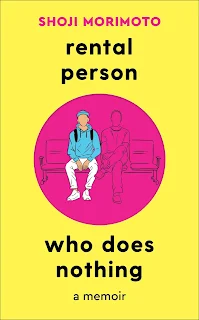
Rental Person Who Does Nothing by Shoji Morimoto book cover

* Copy courtesy of Pan Macmillan *

I first came across the Do Nothing Man from Japan in a BBC documentary called The Japanese man who gets paid to 'do nothing'. I was fascinated by the short doco and intrigued to find out more, eagerly awaiting his new book, Rental Person Who Does Nothing: A Memoir by Shoji Morimoto.

For those new to the concept of renting a person, Morimoto gives his time freely to those who need it but he does nothing. He doesn't charge a daily or hourly rate for his time, and clients pay for any food, drinks and travel expenses incurred. Clients submit their requests for his help online, and Morimoto selects those he can - and wants - to do.

Requests from clients vary, from accompanying them to a concert; visiting a restaurant they've always wanted to go to; attending a temple to say a prayer; or listening to a client share cherished memories of a loved one. The listening requests are common, and the author is clear that he can only provide simple responses.

Morimoto doesn't talk to the client unless they speak to him, he doesn't offer advice and generally only meets a client once. Some of the listening requests were fascinating, with loneliness and social anxiety seemingly forming the basis of many client requests.
"People tend to think that personal matters should be spoken about with those who are close friends, lovers or family members. But since starting this do-nothing service, I've learned that there are a lot of important things that can be talked about with people you don't know very well or even at all. Depth of discussion and depth of relationship don't always go hand in hand." Page 13
I've noticed the variations that can sometimes exist between depth of discussion and depth of relationship where there are no strings attached or expectations to fall short of. I enjoyed seeing some of the requests the author receives, and in doing so I was able to gain smaller unexpected insights into culture and society as a whole.
"Things can be different simply because someone is there. They don't have to be there, but if they are, something changes." Page 6
That's so true for a multitude of reasons! Morimoto notices that requests to visit a client in their home often has an unintentional benefit to the client by motivating them to tidy up prior to his arrival. He also notices that some of his clients need his help to hold themselves accountable. One client wanted him to come and watch them study while reading manga, another wanted him to watch them work. One request was to accompany a woman while she filed her divorce papers. Large or small, the sheer variety of requests is fascinating.
"Since I started this do-nothing service, I've been surprised to discover that there are so many things people want to talk about but can't. At least, they can't talk to people they know. They talk to me, though." Page 59
One example from the book was a woman who wanted to talk about her new girlfriend, but her friends weren't accepting of her choice of lover. She wanted Rental Person to listen to her talk about her new girlfriend and say things like 'she sounds nice' from time to time. Wow! Being able to talk without any fear of judgement clearly helped the client, despite the forced nature of the conversation.

Some clients need to give a loved one bad news or discuss a difficult topic but don't have the confidence or know where to start. After trying out their spiel with Rental Person, the client is able to summon the courage required to have the conversation for real with their loved one.

This was one of my favourite client requests from the book, and it's a little long but I think you'll love it:
"Request: To bump into my dog on a walk and make a fuss of him. Reason: My dog loves people. He goes up to people without dogs and wags his tail, but most of them ignore him, so he gets disappointed. People with dogs often make a fuss of him, but they're busy walking their own dogs and don't have much time, so I try to walk him away, but then my dog gives a little whine and sometimes tries to follow the other person. I don't want him to be thought too irritating so I cajole him into leaving them be, but he always looks upset. He is very positive and gets over it quickly, but it hurts me a bit every time his boundless love comes to nothing, so I always think how nice it would be if a complete stranger would give him some attention.
So I was wondering if you could make a fuss of him, pretending (?) to be a complete stranger who happens to be walking in the opposite direction." Page 130
What a beautiful person and such a lovely request! If you want to know what happened, you'll have to read the book.

Morimoto writes briefly about the Japanese culture of reciprocity and social pressures within friendships and workplaces and understands that many of his clients seek out his services because they feel constrained by their own cultural expectations and community pressures.

For a seemingly introverted and reserved person uneasy about money and not wanting to influence a person's future by having an opinion or making a decision, Shoji Morimoto has created the perfect role in society for himself. As Rental Person, Morimoto is able to help countless people in his unique way, while not shying away from the lack of an income. The author has a wife and child at home and they're living off his savings at the moment, so Morimoto accepts money from clients and wants to ensure nobody mistakes him for a volunteer. 

My only criticism of the book - other than it's too short - is that Morimoto didn't write this memoir. Instead he answered questions with simple responses and an editor and writer wrote the book. It's completely fitting with Morimoto's 'do nothing' persona but this early disclosure at the beginning was disappointing and ultimately lost him a star in this review.

Always introducing himself as Rental Person and wearing his cap so as to seem unassuming while also hiding behind his anonymity when feeling anxious, Shoji Morimoto has helped 4,000 clients since starting in 2018. The demand for services like his tells us something about ourselves and I enjoyed thinking about it. 

Rental Person Who Does Nothing
by Shoji Morimoto is a unique memoir perfect for discussion and I highly recommend it.

My Rating:
★ ★ ★ ★ ★


16 November 2017

Review: Ghosts of the Tsunami - Death and Life in Japan's Disaster Zone by Richard Lloyd Parry

* Copy courtesy of NetGalley *

After reading Richard Lloyd Parry's essay entitled Ghosts of the Tsunami in the London Review of Books, I instantly became obsessed with getting and reading his book, Ghosts of the Tsunami: Death and Life in Japan's Disaster Zone. Parry was living in Tokyo at the time of the earthquake and spent six years as a foreign correspondent visiting and reporting from the tsunami disaster zone.

Shocking facts about the Japanese earthquake on 11 March 2011*
- It was the biggest earthquake ever to have struck Japan, and the fourth most powerful in the history of seismology.
- It knocked the earth 10 inches off its axis.
- It moved Japan four feet closer to America.

Shocking facts about the tsunami that followed*
- The tsunami killed 18,500 people.
- At its peak, the water of the tsunami was 120 feet high.
- The earthquake and tsunami caused more than $210 billion of damage, making it the most costly natural disaster ever.

Review
I didn't know that the Japanese honour their dead ancestors in the form of household altars and memorial tablets. When these were destroyed in the tsunami, the subsequent grief and bereavement was about so much more than the immediate loss of life. The tsunami destroyed memorial books and tablets containing the names of generations of ancestors and even 
ripped open cemetery vaults and scattered the bones of the dead. 

Without their memorial tablets, and important family items, survivors weren't able to honour their ancestors. Entire families lost in the tsunami left nobody behind to honour them and their ancestors. The disaster left a population in deep grief and a feeling that the souls of thousands of ancestors had been suddenly 'cut adrift'.

Parry interviewed hundreds of survivors and many of their experiences are in this book. He tells how survivors "spoke of the terror of the wave, the pain of bereavement and their fears for the future. They also talked about encounters with the supernatural. They described sightings of ghostly strangers, friends and neighbours, and dead loved ones. They reported hauntings at home, at work, in offices and public places, on the beaches and in the ruined towns."

I was hoping to read more about these encounters and the way in which the nation and individual communities dealt with the sudden loss of 18,500 souls. Stories like this one: "A fire station that received calls to places where all the houses had been destroyed by the tsunami. The crews went out to the ruins anyway, prayed for the spirits of those who had died - and the ghostly calls ceased."

However it soon became clear that Parry's overwhelming focus was going to be the story of the children at Okawa primary school. Tragically, the teachers did not evacuate the children to higher ground, despite having more than enough time to do so before the tsunami struck. Parry documents the parent's grief, the search for their children's remains (often lasting years), the process of pursuing the school and government for answers, right through to class legal action; quite unusual for Japan.

Reading Ghosts of the Tsunami: Death and Life in Japan's Disaster Zone was incredibly informative, factual and shocking but at the same time heart wrenchingly tragic.

Unfortunately for the Japanese, the threat of earthquake and tsunami is constant. Parry tells us that in 2012: "a new study concluded that an earthquake and tsunami originating in the Nankai Trough could take 323,000 lives along the south-central Pacific Coast." He also says that "it is generally assumed Tokyo will be shaken by an earthquake powerful enough to destroy large areas of the city......that will kill many tens of thousands of people."

I hope this doesn't happen during my lifetime, although the Japanese seem as prepared as they can be for the inevitable. Until then, this generation will continue to wade through their grief and loss the best way they know how.

My rating = ****

Carpe Librum!

* These facts have been extracted from the book.
09 December 2016

Review: Suicide Forest by Jeremy Bates

Aokigahara is a real forest located in Japan (often called the demon forest) where a large number of people go to commit suicide each year. Jeremy Bates has chosen this location as his setting for the aptly named Suicide Forest, part psychological thriller part horror novel.

I've always been fascinated by this place, and some of you might remember Aokigahara was mentioned in my review of Atlas of Improbable Places - A Journey to the World's Most Unusual Corners by Travis Elborough and Alan Horsfield last month.


Well, reading about the place in the Atlas is what prompted me to bump this book up the list in my TBR pile and I'm so glad I did.


From the blurb alone, you might be expecting a B grade thriller without substance, but you'd be dead wrong. I was on the edge of my seat the entire time, and the sense of foreboding was as palpable as if it were written by the pen of Stephen King.

The forest and the geography of the landscape is the most haunting element of Suicide Forest, and what happens to the young tourists who visit to check it out gives the reader definite cause for concern. There are also many light moments to offset the grim and frightening surrounds and the dialogue between the tourists often had me chuckling aloud.

Suicide Forest is the first novel in the World's Scariest Places series by Bates and is a ripping read. I encourage those who may not read from this genre to ignore the cover and plunge right in.

My rating = *****

Carpe Librum!
20 January 2014

HFVBT Blog Tour & Review: The Gods of Heavenly Punishment by Jennifer Cody Epstein

The Gods of Heavenly Punishment by Jennifer Cody Epstein book cover
* Book from Historical Fiction Virtual Book Tours (HFVBT) for review *

About The Gods of Heavenly Punishment
One summer night in prewar Japan, eleven-year-old Billy Reynolds takes snapshots at his parent's dinner party. That same evening his father Anton, ­a prominent American architect ­begins a torrid affair with the wife of his master carpenter. A world away in New York, Cameron Richards rides a Ferris Wheel with his sweetheart and dreams about flying a plane. Though seemingly disparate moments, they will all draw together to shape the fate of a young girl caught in the midst of one of WWII's most horrific events, ­the 1945 firebombing of Tokyo.

Exquisitely rendered, The Gods of Heavenly Punishment tells the stories of families on both sides of the Pacific: their loves and infidelities, their dreams and losses ­and their shared connection to one of the most devastating acts of war in human history.

My Review
I haven't read many historical novels covering the war between Japan and America, and The Gods of Heavenly Punishment was the first in a long time to grab my attention.

The author introduces us to characters from both sides of the conflict and makes us care about them all in the lead up to World War II.  Admittedly, I didn't know a lot about the Doolittle Raid in 1942 or the Firebombing of Tokyo in 1945, which killed over 100,000 civilians (almost as many as the devastating atomic bombing of Hiroshima).

While The Gods of Heavenly Punishment certainly introduces the reader to these events, the author does so gently and without preaching.  The characters' lives on both sides are entwined in a number of subtle ways, with the final link between characters cleverly revealed at the end.

This historical novel had me gripped, made me laugh, had me shuddering at humanity and thinking deeply about the familial relationships.  I loved the fact that the novel wasn't tied up with a happy ending for each of the characters and I admired the clever exploration of love beyond physical love.

Recommended for readers of historical fiction, war and deep familial relationships.

My rating = ****

Author, Jennifer Cody Epstein
About the Author
Jennifer Cody Epstein is the author of The Gods of Heavenly Punishment and the international bestseller The Painter from Shanghai. 

She has written for The Wall Street Journal, The Asian Wall Street Journal, Self, Mademoiselle and NBC, and has worked in Hong Kong, Japan and Bangkok, Thailand. She lives in Brooklyn, NY with her husband, two daughters and especially needy Springer Spaniel.  

For more information, please visit Jennifer Cody Epstein's website.  You can also find her on Facebook and follow her on Twitter.


Please click here to visit more stops on this blog tour and for your chance to WIN a copy of The Gods Of Heavenly Punishment by Jennifer Cody Epstein.