Italy
Showing posts with label Italy. Show all posts
23 February 2025

Review: All Buttons Great and Small by Lucy Godoroja

All Buttons Great and Small by Lucy Godoroja book cover

All Buttons Great and Small - A Compelling History of the Button, From the Stone Age to Today by Lucy Godoroja was a dry yet interesting read. The Australian author owns her own button shop in Newtown, Sydney and her shop is called All Buttons Great and Small, inspiring the name of this book.

I'd love to visit her button shop one day, but Godoroja is clear from the start that she's not a collector:
"I am not a collector of buttons. I have always, however, been enthralled by them, and over the past 35 years millions of buttons have passed through my hands." Page 1
Over the course of the book, I began to appreciate the author's interests seem to reside in the creation and design of buttons and their materials across time and cultures. However, I did learn some interesting button facts along the way.

Buttons were worn as an adornment, but I didn't know they once served as a portable means of value for the wearer, as it enabled a person to carry their investment with them in the case of an emergency.

Venetian glassmaking is internationally renowned, but I didn't know the establishment of Murano was an inspired government decision:
"With the burgeoning trade in Venice, in 1291 the government of the day made the decision to relocate the glass industry to the island of Murano, for fear of fires from the furnaces breaking out and spreading to the city centre, but particularly, with the added benefit of being able to shield industrial secrets from prying eyes." Page 66
Buttons could be an expression of wealth and King Louis XIV of France shockingly spent more than $5M on buttons during his reign and once commissioned a set of at least 100 diamond buttons. 

I learned that during the 1790s, the Parramatta Justice Precinct was home to the second convict hospital and evidence has been found of colonial bone button manufacturing on this site. It's assumed the many sew-through buttons discovered by archaeologists were made by hand by the convicts recuperating in the hospital or living in the huts on site.

I learned the difference between pottery and porcelain:
"Clay is the basic material of all types of pottery, but while porcelain is a type of pottery, not all pottery is porcelain. True porcelain is known as 'hard paste' as it requires hard firing at very high temperatures, after which it becomes extraordinarily dense." Page 104
More interesting though was reading the brief section about koumpounophobia, the fear of buttons. Steve Jobs openly admitted suffering from this phobia, hence his preference for wearing skivvies or polo necked tops rather than shirts.

Those few highlights aside, there was way too much information provided on scientific developments and inventions of particular materials used to produce buttons for my liking. I didn't find it interesting at all to read about the evolution of various button making materials, and the chapter entitled The Plastics Evolution - comprising the invention and use of shellac, rubber, semi-synthetics, synthetics, bakelite, amino plastics, acrylic, plexiglass, perspex, lucite, acrylite - nearly sent me to sleep.

Borrowed from the library, button lovers and crafters won't find any button inspired artwork here. There's no chapter about button collections around the world - or within Australia - or research around the discovery and value of rare and precious buttons. High-end fashion designers and their use of buttons was included, but this wasn't of interest to me. There were some stunning colour photographs of buttons throughout this beautifully produced hardback, but ironically the captions didn't contain enough detail. There is an impressive bibliography and index, but no button trading or shopping references in the index or websites to visit.

All Buttons Great and Small - A Compelling History of the Button, From the Stone Age to Today by Lucy Godoroja is an academic button book for serious collectors, sellers or historians interested in the materials used to make buttons from ivory, wood and tortoiseshell right through to metals, alloys and plastics. I have a moderate interest in buttons but unfortunately it didn't extend this far.

My Rating:


30 August 2024

Review: This is My World by Lonely Planet Kids

This is My World by Lonely Planet Kids book cover

This is My World
by Lonely Planet Kids was a delightful reading experience as 84 children from around the world tell us about their family, where they live, their hobbies and more. Each child enjoys a double page spread, and the eye-catching layouts include photos, flags, maps, fast facts and three adjectives they use to describe themselves.

Cleverly organised alphabetically by first name provides a stimulating criss-crossing of the globe instead of a dull trip alphabetically country by country. This also prevents readers from flipping pages to search for specific countries, although there is a handy index in the back.

Some of the entries are clearly written by the children while some have been helped by their parents, but all were informative, interesting and engaging. I loved learning new things along the way, for instance Noa (aged 10) lives in Japan and she says:
"I like this house because our living room is huge. There is a fireplace and horigotatsu (table-based heater) as well." Page 129
I didn't know what a horigotatsu was so put the book aside to find out and went down a lovely Japanese rabbit hole. They look super cosy and I really hope I get the chance to try one some day.

I was able to identify some similarities between the entries in that a lot of children fight with their siblings (who knew?), many have never seen snow and rabbits are a favourite animal for kids around the world.

According to the Foreward:
"To create this book, we reached out to cattle ranchers in the Australian outback, inhabitants of a fishing capital in Greenland, city dwellers living among skyscrapers in Nigeria and many more families!"
Sounds great but I'd really like to know exactly how they did that. How many children submitted a response and how were these 84 profiles chosen? Some of the children stated their parents were teachers and I found myself wondering if Lonely Planet reached out to schools as part of this project. Not that it's important, I'm just curious.

This is My World by Lonely Planet Kids is a great book suitable for readers young and old and I can highly recommend it.

My Rating:


28 April 2023

Review: One Illumined Thread by Sally Colin-James

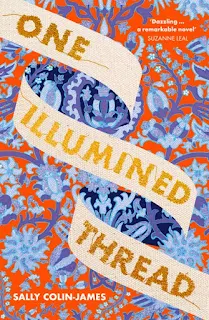
One Illumined Thread by Sally Colin-James book cover

* Copy courtesy of Harper Collins *

One Illumined Thread by Sally Colin-James is an historical fiction novel about the lives of three women linked across three very different timelines. In Hebron, 41 BCE Elisheva is a married woman ostracised by her community because she's been unable to bear a child. Antonia is the wife of an artist in Renaissance Florence and we pick up her thread (pun intended) in 1497. Our contemporary narrator is Doctor Reed, a textile conservator living in Adelaide in 2018 and all three characters were compelling.

Establishing the unique identity of each of the three main characters was a little tough at first, but I was helped along by the talented writing of Colin-James and her ability to keep re-introducing characters to the reader in a helpful manner reminiscent of Philippa Gregory.

Fertility, motherhood and womanhood are key themes in each of the narrative arcs:
"That's us women. Often invisible. But strong like the wind. And most men, if asked for the truth, would say that when it comes to the household they sail to conditions." I didn't understand what she meant until many years later. Page 226
Connecting the lives of these women across the centuries are artisan crafts, primarily glassblowing and painting. In the Judean timeline, Elisheva shakes off the disapproval of the women in her village to become a talented glassblower, with her work based on the history of Hebron glass.

The narrative set in Florence is based heavily around the painting La Visitazione by Mariotto Albertinelli (1503) which features the visitation of the Virgin Mary to Elizabeth. Antonia is married to Albertinelli and friends with Michel (Michelangelo) and is passionate about her pursuit of the perfect white.
"Without white there is no moon," he declaimed. "No stars in our night sky, no flour for our bread, no lilies for our vases. No clouds, no mists, no sudden snowstorms, no mountains of marble." ... "White is where a painter begins and where his brush ends, on the gleam of an eye: a touch of white on that black pupil is what brings the portrait to life. Without white there is no art!" Page 271
Flitting between chapters about artists in Florence grinding pigments in the time of Savonarola, and the threats of violence by King Herod's Army, it was a relief to rejoin our conservator in the somewhat safer space at the Adelaide International Gallery.

Each of the women is striving to reach their inner potential, and the reader will identify with the struggles they face, even if they're of another time and place. There is plenty of character growth and development here with character insights along the way. I particularly related to this one:
"Sometimes, as children, we make too much of the people who pass through our lives. They seem grand and beautiful in the context of our world, but really they're just like every other human. Preposterous and vain." Page 193
Those familiar with their history will be rewarded when reading the narrative set in Judea under King Herod's rule, and it's clear - although not obvious - how much time and effort has been invested in the research for this novel. 

One Illumined Thread by Sally Colin-James is a solid debut and I agree with the publisher's recommendation that it will appeal to readers of Maggie O'Farrell and Pip Williams. Here's a phrase I particularly enjoyed that immediately put me in mind of Hamnet or The Marriage Portrait by Maggie O'Farrell.
"My mother casts me a glance sharp enough to slice onions." Page 18
When I see sharp (pun intended) writing like this by a debut author - and an Australian author no less - I'm excited to imagine the pages she will write in the future. Sally Colin-James expertly weaves (sorry, couldn't help it) all three narratives of One Illumined Thread together in a meaningful and satisfying conclusion that I can highly recommend to fans of historical fiction.

My Rating:


14 August 2022

Review: The Brightest Star by Emma Harcourt

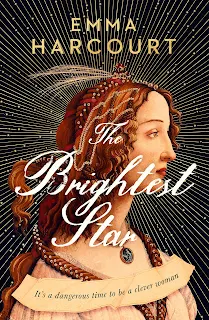
The Brightest Star by Emma Harcourt book cover

* Copy courtesy of Harper Collins *

Set in Florence, The Brightest Star by Emma Harcourt starts in 1479 with the birth of Leonarda Lunetta (Luna) Fusili. Luna is born with a misshapen leg and is immediately rejected by her mother. The eldest daughter of Signore Vincenzio Fusili, Luna is brought up with reading, debate, science and astronomy, usually the preserve of male heirs.

Twenty odd years later and Luna's father is supporting the Medici family in secret after Piero di Lorenzo de’ Medici's banishment from the city. Renaissance Florence is beset by fundamentalist preacher Friar Girolamo Savonarola who reminded me a little of the High Sparrow in Game of Thrones. Luna finds herself taken in by him at one of his sermons:
"Luna heard tenderness in his entreaties to the congregation and there was a murmur of agreement from the floor. The people swayed and gasped as one as the preacher grew ever more impassioned. Luna swayed just as the strangers around her did, and there was a warm fealty in doing so." Page 127
When piles of precious books are burned and neighbours thrown out into the street for heresy, a feeling of dread pervades the family. Luna has a passion for learning and longs to continue her studies but her step mother's insistence she be wed or attend a nunnery on account of her leg is thwarting her plans for the future. Luna has received an education usually reserved for boys and she fights the inequality between the sexes, her lack of agency and the ignominy of her disability. Luna is a terrific protagonist and I really felt for her as she strived for what she wanted and fiercely resisted having her future decided for her.

Despite the political tensions and the danger of incurring Savonarola's wrath, there are moments of light dialogue and sensational writing. I particularly liked this phrase:
"Now, wash your hands and find your sister for me. She frolics somewhere outdoors and ignores my calls to come inside. Her antics age me ten moons in a day." Page 57
Ten moons in a day, I think we can all relate to how that must feel!

The Brightest Star is well researched by this Australian author, the Florentine setting felt authentic and I enjoyed the period details. I particularly enjoyed the two references to the period of the evening where the 'second sleep' of the night takes place on pages 77 and 167. Regular Carpe Librum readers will know this is one of my favourite nuggets of history surrounding sleep.

The introduction of Nicolaus Copernicus as a minor character in the second half of the novel was a nice surprise and I enjoyed following Luna as she grew and matured into a young lady.

Reading The Brightest Star by Emma Harcourt put me in mind of TV series The Borgias and I'm listening to that soundtrack right now as I compose this review. 

The Brightest Star by Emma Harcourt is highly recommended for historical fiction readers and those interested in Renaissance Florence, the power of a classic education, a disabled protagonist and a love of astronomy.

Read a FREE extract here.

My Rating:


22 March 2016

Winner of Ian Ross Twilight of the Empire series announced


Thanks to those who entered last week's massive giveaway of 3 paperback books from author Ian Ross. The giveaway was open internationally and many readers entered to win the Twilight of the Empire series pictured below.

Entries closed at midnight Friday 18th March, and congratulations goes to:

Waughzone67


Congratulations Waughzone67, you'll receive an email shortly advising you of your win and will have 7 days to provide me with your postal address. Your prize pack valued at $90AUD will be sent to you directly by Harper Collins Publishers Australia, who I'd like to thank for their generosity.

For those who missed out, click here to win some crime fiction in this week's giveaway.

Carpe Librum!


11 March 2016

Friday Freebie WIN 3 paperback books by Ian Ross from his Twilight of the Empire series valued at $90 AUD

* Copies courtesy of Harper Collins Publishers Australia *

Today's Friday Freebie is a massive giveaway of 3 paperback books from author Ian Ross valued at $90AUD and it's open internationally. Enter below to win his Twilight of the Empire series.

RRP $29.99AUD
War at the Edge of the World
Centurion Aurelius Castus - once a soldier in the elite legions of the Danube - believes his glory days are over, as he finds himself in the cold, grey wastes of northern Britain, battling to protect an empire in decline. 

When the king of the Picts dies in mysterious circumstances, Castus is selected to guard the Roman envoy sent to negotiate with the barbarians beyond Hadrian's Wall. Here he will face the supreme challenge of command, in a mission riven with bloodshed and treachery that tests his honour to the limit.

As he struggles to avert disaster and keep his promise to a woman he has sworn to protect, Castus discovers that nothing about this doomed enterprise was ever what it seemed.

RRP $29.99AUD
Swords Around The Throne
Rome is in peril. The old order is changing - and Aurelius Castus has been summoned back from Britain to find himself caught up in a treasonous conspiracy threatening to bring down the Emperor Constantine.

Rewarded for saving the emperor's life in battle, Castus is promoted to the Corps of Protectores, the elite imperial bodyguard. The swords around the throne.

But he soon discovers the court to be as dangerous as the battlefield; behind the gilded facade of empire, there are spiralling plots, betrayals and seductions. A nest of traitors. And one relentless enemy.

Battle For Rome
RRP $29.99AUD
The Roman Empire is on the brink of civil war. Only Maxentius, tyrant of Rome, stands between the emperor Constantine and supreme power in the west.

Aurelius Castus, promoted from the ranks for valour and loyalty, is now a tribune in Constantine's army. But great honour brings new challenges: Castus is tormented by suspicions that his aristocratic wife, the mother of his child, has been unfaithful. And as Constantine becomes increasingly devoted to Christianity, Castus is forced to ask himself whether he is backing the wrong man. 

All know that the coming war will decide the fate of empire. But Castus's own battle will carry him much further - into the shadowy realms of treachery at the heart of Rome itself.

Author Bio
Ian Ross has been researching and writing about the later Roman world and its army for over a decade. He spent a year in Italy, teaching English, but now lives in Bath. Visit his website: www.ianjamesross.com or find him on twitter: @IanRossAuthor

Giveaway
This giveaway has now closed.
26 August 2015

Review: Signora da Vinci by Robin Maxwell

Robin Maxwell is one of my favourite historical fiction authors and she's written about some famous and influential female figures from history, including: Anne Boleyn and Elizabeth I.

Signora da Vinci is told from the perspective of Leonardo da Vinci's mother, Caterina. We begin in 1452, when Caterina gives birth out of wedlock to Leonardo. Her heart is broken when her lover's family refuse to accept the match and rip Leonardo from her arms to raise in their - more noble - family.

Caterina is an apothecary after her father, who is a well-travelled, well-read and respected man in their little town of Vinci in Italy. When her son becomes a man, he moves to Florence and Caterina wishes to see him. Not being able to travel alone (as a woman) and fearing recognition from Leonardo's father, she disguises herself as a man and changes her name to Cato.

Her disguise works and the novel really takes off from here. Lorenzo de' Medici becomes Leonardo's patron and Cato one of his closest friends.

Signora da Vinci is filled with art (the great Botticelli is also a character), religion (including the making of the Shroud of Turin by Leonardo) alchemy and the pursuit of knowledge, however forbidden it might be. 

Cato is invited to join The Platonic Academy and I thoroughly enjoyed his deception and the insights Caterina was able to get from carrying herself as a man. I also have a new appreciation for the portrait of the Mona Lisa, but no spoilers here.

Not much is really known about Leonardo's mother Caterina, and so when reading Signora da Vinci you will enjoy it more if you suspend your disbelief and just dive in. It's fair to say that a number of liberties have been taken with dates and events, but the period has been well researched and this is a fun 'what if' read.

My Rating = ****


Carpe Librum!