Diary
Showing posts with label Diary. Show all posts
11 May 2026

Review: The Secret Rooms by Catherine Bailey

The Secret Rooms by Catherine Bailey book cover

This was a brilliant read! The Secret Rooms - A True Gothic Mystery by Catherine Bailey is the result of a tonne of research delivered in a gripping narrative non fiction style that had me telling multiple people about it before I'd even finished.

If you'd asked me if I cared about the life of the 9th Duke of Rutland and his family, I'd have said no. What about the history of Belvoir Castle? I'd probably have given it a Google, marvelled at the impressive architecture, looked at any available images of the interiors and then moved on. So why did I pick this book up? In one word? The blurb! (Or is that two words?) The blurb contained a really good mystery I wanted to know more about and I love when rooms are locked for decades and then re-entered.

In 1940, John the 9th Duke of Rutland was one of Britain's wealthiest men, yet he died holed up in the servant's quarters of Belvoir Castle. Living out his last days secluded in an area comprising five damp rooms, doctors firmly encouraged him to move to luxurious accommodations elsewhere in the castle but John refused.

After his death, John's son closed up the rooms and they remained locked and untouched for sixty years. Author and researcher Catherine Bailey was one of the first to be granted access to these rooms and there she discovered what John had been feverishly working on right up until his death. Of course I wanted to know, don't you?

The Secret Rooms was published in 2012 and it's mentioned in the blurb so it's not a spoiler to say that John was an obsessive collector and had been organising and cataloguing his family's correspondence. The family archive contained hundreds of files spanning nine hundred years of history and contained tens of thousands of documents. On closer inspection, the author discovered that letters for three distinct periods in John's life - in 1894, 1909 and 1915 - had been removed from the collection. Why? Was he trying to hide something? And what was it?

Bailey draws on the contents of the available letters and diary entries in addition to military records and other sources in order to piece together what happened in John's life during these periods that he was trying to conceal.

Belvoir castle is in Leicestershire and built in the Gothic style with 356 rooms and I loved learning about it. It's an impressive looking structure and thankfully the book includes a comprehensive floor plan which was incredibly useful.
"The servants - maids of all descriptions, odd-job men, footmen, the flag man, the hall porter, the telephone boy, the boiler stoker and the stewards' room boy - were seated on the two benches that ran either side of a long table beneath a photograph of King George VI." Page 14
Of course, this wasn't all of the servants, you also have the housekeeper, butler, valet, chaplain, coal carriers, watermen, watchmen, lamp men and more. It's like Downton Abbey on steroids.
"In 1899, the castle had a groom of chambers, a house steward, an usher of the hall, a chef, a pastry chef, a confectioner, a plate butler, a clockman, a steward's room boy - and housemaids, kitchen maids, scullery maids, footmen, odd-job men, and porters galore." Page 169
"In the castle's grounds, there were hundreds more: grooms, stable lads, dairy maids, studmen, brewers, rat catchers, mole catchers, millers, mechanics, gardeners, groundsmen, gamekeepers, river keepers, huntsmen, kennelmen, slaughtermen, stockmen, horsemen, farm hands and woodsmen." Page 169
Bailey explains that in 1914, there were thirty Dukes - the highest honour the Crown could bestow - and they enjoyed privileges that seem scarcely credible to today's reader. This family had ruled over the neighbourhood for eight hundred years and some of the scenes described of family funerals held on the estate were extraordinary.

The astute among you will have noticed that one of the gaps in John's family correspondence occurred during the First World War and it's fair to say that a good deal of the research Bailey relates takes place during the war. This may deter some readers, however the author strings the narrative together so well by including telegrams (damnation!) and letters that keep the pace trucking along and on topic.

Bailey takes the reader along for the ride and has distilled John's life to a ripping tale and I thoroughly enjoyed getting to the bottom of the three 'secrets'.

In the Acknowledgements section of the book, the author thanks her mother Carol for deciphering and typing out the many thousands of letters she found. I have so many questions about this and the book that I'm currently trying to track down the author in order to invite her to conduct an interview with me for Carpe Librum. Catherine, if you're reading this, I'd love to know more about your research for this book so please get in touch.

The Secret Rooms by Catherine Bailey contains family secrets and cover ups, overzealous matchmaking, military movements and misdeeds, cryptology, pathological behaviour, aristocratic abuse of power and a privileged way of life many of us cannot begin to comprehend.

Highly recommended and an unexpected contender for My Top 5 Books of 2026.

My Rating:

Carpe Librum!

23 September 2024

Review: Cuddy by Benjamin Myers

Cuddy by Benjamin Myers

Cuddy by Benjamin Myers is an historical fiction novel told in a blend of writing styles, including: narrative prose, quotes from historical reference books, poetry, diary entries and even a play. Anticipating a novel about the life of Saint Cuthbert of Lindisfarne told in a fictional first person point of view, Cuddy was an unexpected story.

Born in 634 AD in Northumbria (modern day Scotland), Cuthbert had been a monk, a prior and a bishop and was a hermit at the time of his death in 687 AD. Beloved in life, many came to pray at his grave at Lindisfarne and were healed. Deciding to elevate his remains as relics on the anniversary of his death, his body was found intact - hadn't decomposed - and he was declared a saint. Pilgrims visited the shrine for decades until Viking raids threatened the area.

Cuthbert's body was transferred to a coffin and transported by a dedicated group of worshippers seeking a safe resting place for their beloved saint. On the move until the year 995, a site was finally chosen and a series of churches were built to house St Cuthbert's remains. Construction of Durham Cathedral commenced in 1093 and still houses the Shrine of St Cuthbert today.

Pieced together from the non fiction quotes in the book, I share all of this because it's a fascinating slice of history and if you're still reading, it means you agree. Myers has created characters from each of these periods of Cuthbert's history in the wildly different formats mentioned above.

We hear from Cuthbert (affectionately known as Cuddy) early in the book but he's already close to death:
"Well now. You should have been here a candle or two ago. The scenes of despair amongst the monks at my final days of retreat to this bluff in the foaming ocean was quite the picture." Page 7
I love that phrase, 'a candle or two ago.' In Book I we join the religious folk in 995 AD carrying Cuthbert's remains and an orphan girl who has visions regarding his final resting place.

In Book II we jump to the year 1346 and through the eyes of the fletcher's wife, meet a stonemason engaged in building the great Durham Cathedral. The work of the mason and the history of the stone - then and now centuries later - was beautifully written:
"In the stone is yesterday's sun and the stories it has seen, not only of wandering holy folk and the fiery Norse, not only old white churches and milkmaids, galloping Frenchmen and the green men that took to the trees but other details not always pressed to the page by monks. Everything the stone has borne silent witness to is held within it now...... Rainstorms and quarrymen, Picts, plague pits and paupers, hawkers and jesters, skirling new life and coughing old death, archers and anglers, devils and angels, sunrises and sunsets, courting couples sitting on stone walls watching snowfall, villeins and franklin and wandering freemen, nets of cuttlefish and pails of crabs, sores and scabs, bed-bound mothers and gaoled fathers, babies - a thousand wailing babies - and church bells, cabbage soup and nettles and worms and sacks and jam and garlic and knives and deer and murder and toll gates and caravans and soothsayers and plums and coffin-makers and lepers and laughter and ice and logs and oats and sex and sin and Cuddy and Jesus and God." Page 237
I know that was a long quote, but it perfectly captures the awe and wonder I feel when gazing at a Cathedral built more than 1000 years ago and I want to be able to revisit these words again, even if I no longer have the book.

Leaving those characters behind to leap forward a few centuries, the Interlude was based on a haunting and shocking account of history. In 1650, Durham Cathedral was used as a prison by Oliver Cromwell to house 3,000 Scottish prisoners of war. Suffering in the cold without food or water, the prisoners destroyed the pews and burned the timber in order to keep warm. Devastatingly, 1,700 soldiers died from battle injuries, dehydration and starvation and were buried in mass graves nearby.

This is a disturbing chapter of history I knew nothing about but certainly won't forget, as the author has created a macabre play for the Interlude, whereby several soldiers being held captive engage in dialogue with eachother and the cathedral. Yes, you read that right.

It was a relief to reach Book III covering the period in 1827 when an arrogant Professor from Oxford travels to the Cathedral to oversee the disinterment of the saint in order to verify his remains are uncorrupted. Diary entries tell this tale and the character is haunted by his complicity and fears for his sanity. I felt the author's outrage at the desecration and believe the character met a satisfying fate. 

Book IV brings us to 2019 and it was perhaps an unnecessarily long tale to deliver the reader to Durham Cathedral and the tomb of St Cuthbert.

Cuddy by Benjamin Myers seemed to me to be the story behind the building of Durham Cathedral over time told through the lives of a handful of individuals:
"My story, and that of Fletcher Bullard, just one story in a thousand million stories that combine to define a place, concludes thusly:" Page 263
While brief, each serves as a complete story and while the reader may be reluctant to leave a character or point in time, their stories reach a natural conclusion of sorts.

A word on the layout as there were several techniques that were used - presumably - to impress but which I found slightly irritating. In one case, a character's visions were presented in one continuous paragraph with font that slowly reduced in size until it was barely readable by the end. Elsewhere, poetry was presented with varying alignment choices that left me cold, with just one word or sometimes even one letter per line. I guess you could say that while I enjoyed the mashup of writing styles within Cuddy, the unconventional layout choices fell short of the mark.

The descriptions of the cathedral from characters across time were incredible, with the 2019 character of Michael describing the vast edifice before him as enrapturing. It certainly had me pausing at certain times in the novel to research a fact or take a virtual tour of the cathedral and I'd love to visit in person one day, even just to see the sanctuary knocker.
"The face of the Sanctuary Knocker then, is that of the lonely miscreant, the damned, the doomed, the cursed, the blasted, the blighted, the bedevilled, the fated; he who shall live their life seeking God's eternal forgiveness alone." Page 197
Now that I've finished reading Cuddy, I believe it to be the complex history of Durham Cathedral rather than the story of a saint. This unique blend of fact and fiction and multiple writing styles felt original and is recommended for fans of Ken Follett and his series beginning with The Pillars of the Earth.

Prologue AD 687
Book I Saint Cuddy AD 995
Book II The Mason's Mark AD 1346
Interlude The Stone Speaks AD 1650
Book III The Corpse in the Cathedral AD 1827
Book IV Daft Lad AD 2019

My Rating:


20 August 2024

Review: Theft by Finding Diaries 1977-2002 by David Sedaris

Theft by Finding: Diaries 1977-2002 by David Sedaris audiobook cover

Books by David Sedaris have been a somewhat regular feature here on Carpe Librum since 2021, and this offering marks my 7th review of his work. I have tickets to see David Sedaris live when he comes to Melbourne next year and thought I'd tackle the first volume of his diaries after they were recommended by an author whose recommendations I trust.

Theft by Finding: Diaries 1977-2002 by David Sedaris covers a huge chunk of his life, although Sedaris is clear at the outset that the diary entries selected for this collection are a mere drop in the ocean.
"It's worth mentioning that this is my edit. Of the roughly 8 million words handwritten or typed into my diary since September 5 1977, I'm including only a small fraction. An entirely different book from the same source material could make me appear nothing but evil, selfish, generous or even - dare I say - sensitive. On any given day I am all these things and more: stupid, cheerful, misanthropic, cruel, narrow minded, open, petty, the list goes on and on. A different edit, no doubt a more precise one would have involved handing my diary over to someone else, but that is something I cannot imagine doing, unless perhaps, that person is a journalist. They never get beyond the third page, which they usually call the middle, as in 'I'd hoped to finish this before our interview but am only in the middle'." Chapter 1
Beginning in 1977, the diary entries provide a wonderful snapshot of life at the time, reflecting the attitudes and social norms of those around him. Sedaris is a master of observation and conversation with people and he shares multiple snapshots into lives that merely intersected his for moments, days or weeks.

Living in poor neighbourhoods and taking odd jobs to pay the rent, Sedaris seemed to be surrounded by a lot of domestic conflict often leading to outright domestic violence. The author also shares multiple accounts of bullying and harassment while walking on the street, riding his bike and generally out in public, most of which he tries not to engage with.

The rise of AIDS is barely touched on although Sedaris often mentions he's mistaken for a woman on the phone and is called a fag by strangers when he won't give them cigarettes or money etc. There's no inner reflection or deep interrogation of his thoughts and feelings on these topics and I'm not sure whether he chose not to record them at the time or merely decided not to include them in this collection. Sedaris does mention he regrets not recording word-for-word conversations with family members in his diary as some of them have since died and he'd like to re-read them.

I've mentioned Sedaris' drug taking in the past and I really didn't enjoy the amount of air time given to his recreational drug use. He doesn't share any real reason for his drug taking or discuss any mental struggle related to the activity, perhaps preferring to keep it private. He does mention giving up alcohol and staying sober, but it's not a big focus and there wasn't any of the expected deep inner reflection.

Meeting his partner Hugh in 1990 was a highlight and I enjoyed tracking his early involvement in stage plays and the joy at his rising success via reviews and interviews, and later his early books. But again, my favourite sections were the entries written when he was taking a course to learn French. His sense of humour and love of word play definitely shone through, and I admired his effort to embrace the language. One favourite entry involved Hugh cutting his finger with a knife, and Sedaris racing down to the store not knowing the word for bandaid, and saying:
"My friend cut his finger and I am looking for a morsel of rubber." Chapter 23
Hugh later points out that the correct phrasing is 'cut of himself the finger' and Sedaris finds himself hoping Hugh will injure himself again so that he can return to the store with both the reflexive verb to 'cut of oneself' and the proper word for bandaid. Love it!

The advantage of a diary format is that the entries are relatively short in length, however the inevitable payoff is that the format can become a little repetitive after a while. Sometimes an engaging entry was included without a follow up that left me hanging (did his cat recover?) or wondering what happened only for the next entry to pick up weeks later.

This audiobook comes in at just under 14 hours and is therefore quite the commitment. Volume 2 A Carnival of Snackery: Diaries 2003-2020 comes in at a whopping 17+ hours so I don't imagine I'll be getting to that any time soon. If anything, I may listen to The Best of Me by David Sedaris before I see his show in February 2025 as I've had quite enough of the diary format for now.

My Rating:


30 November 2022

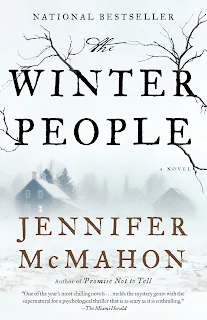
Review: The Winter People by Jennifer McMahon

The Winter People by Jennifer McMahon book cover

Published in 2014, The Winter People by Jennifer McMahon has been on my virtual 'maybe' list for several years; okay I'll admit it, 8 years. During this time, the author has published several new novels the blurbs of which have also piqued my interest; I'm looking at you The Drowning Kind and more recently The Children on the Hill. I'm the kind of reader who sometimes prefers to try an older title before deciding if an author is worth continuing on with, so thanks to my library for making that possible.

The Winter People is a paranormal mystery set in West Hall, Vermont, replete with strange disappearances, ghost sitings, myths and legends surrounding a circle of stones called the Devil's Hand and a ring made of bone.
"They think that there's something out there, in the woods at the edge of town, something evil, something that can't be explained. There have been a lot of stories over the years, folks who've gone missing, people who say they see strange lights or hear crying sounds, tales of a pale figure roaming the woods. When I was a boy, I thought I saw something myself one time: a face peering out at me from a crack between the rocks. But I moved closer and it was gone." He made his eyes dramatically wide and gave a little chuckle. "Have I scared you yet?" Page 132
The story alternates between time periods - 1908 and the present day - and different character perspectives (Ruthie, Katherine, Martin) and also includes diary entries from The Secret Diary of Sara Harrison Shea that add to the layers of suspense. Eventually the author skilfully brings all of the stories together and in doing so, solves the mystery.

The clever plotting reminded me of the likes of Ruth Ware or Laura Purcell, although I already read quite a few accomplished authors in this particular niche.

The Winter People has been classified by many readers as horror, however I found it only mildly creepy, if that. I believe it belongs more fittingly in the category of YA historical fiction and domestic noir with a touch of the paranormal and supernatural and it was a good choice for the October / Halloween reading schedule.

The Drowning Kind was published in 2021, so based on previous trends, I'll probably get to it in 2029! Have you read any books by this prolific author?

My Rating:


22 July 2020

Review: This is Going to Hurt: Secret Diaries of a Junior Doctor by Adam Kay

This is Going to Hurt: Secret Diaries of a Junior Doctor by Adam Kay audiobook cover
My latest foray into listening to non fiction via audiobook is This is Going to Hurt: Secret Diaries of a Junior Doctor by Adam Kay. Recommended by my friend Andrea and narrated by the author himself, Adam Kay is a retired Obstetrician and Gynaecologist and these days he's a writer and comedian.

In This is Going to Hurt, Kay shares a series of diary entries from his time working for the NHS in 2004 - 2010. These diary entries include brief patient stories and observations about his work as a junior doctor. Some of the entries were sombre, some funny, some interesting, some educational and all were entertaining in their own way.

I enjoyed the fact this audiobook can be listened to in short or longer chunks of time; whichever suits the listener/reader. It was easy to stop between diary entries for the day and a relief not having to wait for the end of a chapter to do so.

Living in Australia, I don't have any direct experience with the NHS but Kay paints a frustrating picture of the demands on junior doctors and the bureaucracy of the system at large. He also evokes enormous admiration for the medical community in a time when respect for doctors, nurses and medical staff couldn't be greater. They're both on the front line and the last line of defence in this Coronavirus pandemic and we depend on them for our very lives.

This is Going to Hurt: Secret Diaries of a Junior Doctor by Adam Kay was enjoyable and funny with an underlying message about the state of the NHS that is especially relevant today.

Carpe Librum!

My Rating:
★ ★

26 June 2019

Review: Wakenhyrst by Michelle Paver

Wakenhyrst by Michelle Paver book cover
* Copy courtesy of Harper Collins *

Wakenhyrst by Michelle Paver is a gothic mystery set in a fen in Edwardian Suffolk surrounded by folklore, superstition and legends. The ancient manor house of Wake's End near the hamlet of Wakenhyrst has been Maud's home for the past 50 years where she's lived as a recluse. Maud's story is closely connected with that of her father, historian Edmund Stearne and the mystery of the crime he committed in 1913.

The reader is taken back in time to Maud's childhood and her overbearing father's increasing obsession with 15th Century mystic Alice Pyett. A medieval Doom painting is discovered in the nearby Church and Edmund is affected by the artist's depiction of the Last Judgement. Maud discovers her authoritarian father's diary and we interpret the content along with Maud as she tries to figure out what's happening.

I can understand why some readers will find Wakenhyrst a slow read, but that's what builds the tension. Gothic tension takes time, and Paver does an excellent job of allowing the reader to see every single stage of Edmund's decline.

I enjoyed the overall setting of Wake's End, including the members of the household and the superstitions of the local people about the fen. Secrets and the sins of the past are also present, as is a feeling of otherworldly goings on. Paver does a brilliant job of setting the scene and I especially enjoyed the reference to Quieting Syrup on page 246:
Nurse hated her for pointing out that as Quieting Syrup is a mixture of black treacle and opium, it is hardly advisable to give it to a four-year-old.
I fell into Wakenhyrst by Michelle Paver with immediate gusto, and the early chapters gave me the same bookish shivers I had at the beginning of The Binding by Bridget Collins. I love the cover art and animal lovers will enjoy knowing that the magpie on the cover has a role to play in the novel.

When we've reached the climax of the story and finally get back to the present, the ending seems hastily wrapped up in comparison to the slow burn of the rest of the novel. I found this quite jarring and wanted a little more time with Maud.

I thoroughly recommend Wakenhyrst by Michelle Paver for fans of historical fiction and gothic suspense novels.

My rating = *****

Carpe Librum!

P.S. If you enjoy gothic novels or want to find out what makes a novel gothic, check out my list of Gothic Tales To Read for more info.
27 April 2019

Review: Under the Midnight Sky by Anna Romer

Under the Midnight Sky by Anna Romer book cover
* Copy courtesy of Simon & Schuster *

As the cover suggests, Under The Midnight Sky by Australian author Anna Romer is a dark mystery novel set in Australian bushland.

Abby lives in a small township called Gundara and has a dark past. She's a journalist for her local newspaper and is obsessed with the murders that took place in Deepwater Gorge many years ago. Her personal level of involvement in the crimes is the first mystery of the novel.

Reclusive author Tom Gabriel has purchased a ramshackle country manor known as Ravensong, and recently moved to the area to work on his new book. Abby wants to interview Tom for the newspaper and despite his aloof and gruff demeanour, they strike up a friendship of sorts. When Abby discovers a hidden room in an attic at the top of his house, they begin to pool their resources and investigative skills to get to the bottom of several mysteries before them. This includes the case of a current girl who may have gone missing.

Under The Midnight Sky is a mystery novel that could just as easily be called crime or rural crime. The Australian setting and relaxed dialogue made the novel feel instantly relatable.

The alternate time periods (present and 1940s-1950s) were handled well, although I did struggle at first with the numerous character perspectives. We had first person perspective from Abby, first person diary entries from another character and third person perspectives from Tom, Lil and Joe. Not to mention third person perspective from the missing girl and perhaps others I've missed. There was no indication at the beginning of each chapter as to which character we were with and I really had to concentrate to follow the plot threads.

Under The Midnight Sky is a dark mystery full of secrets, family trauma, sibling love, burgeoning love, obsessive love and enduring love. Themes of memory and family are also explored with a significant reveal at the end. The slow burn romance that developed between two characters started off well, until he called her 'hon' which made me cringe.

Under The Midnight Sky was an engrossing read but is losing a star because two bodies weren't re-homed/re-buried at the end.

My rating = ***

Carpe Librum!

P.S See my review of Beyond the Orchard by Anna Romer.
27 March 2019

Review: The Stranger Diaries by Elly Griffiths

The Stranger Diaries by Elly Griffiths cover
* Copy courtesy of NetGalley *

The Stranger Diaries by Elly Griffiths is a gothic cozy murder mystery with literary leanings and I really enjoyed it.

The story is told from the perspective of three main characters, teacher Clare, daughter Georgie and DS Kaur. Clare is a literature teacher with a passion for the work of gothic writer R.M. Holland. Clare teaches at Holland House, Talgarth High School, the building where the reclusive R.M. Holland lived and wrote The Stranger.

When Clare's friend and colleague Ella is found dead, clues seem to point to the well known ghost story by R.M. Holland, The Stranger.

Set in rural England, this is a classic whodunnit with plenty of literary references. I enjoyed the alternate perspectives of daughter Georgie and DS Kaur's investigative process.

The Stranger Diaries is an enjoyable cozy murder mystery with plenty of potential suspects and I enjoyed the gothic undertones and satisfying conclusion. The inclusion of the short story The Stranger at the end was a bonus.

My rating = ****

Carpe Librum!
05 September 2018

Review: Everywhere I Look by Helen Garner

I discovered this little gem of a book on one of the shelves in the free little library I started in my apartment building. The library has been successfully running for 12 months now and the reason the discovery was so exciting is because it was the first book to be donated that I personally wanted to read. Woohoo!

Everywhere I Look by Helen Garner is a collection of essays and diary extracts about a whole host of unrelated topics, written - and published elsewhere - over the last two decades or so.

This was my first introduction to Garner's writing and I now understand the reverence in which she's held. Helen certainly knows how to wield a pen and her everyday observations were enjoyable to read.

Her writing on the topics of ageing and being an 'invisible woman' were most interesting, as were her thoughts on several true crimes that occurred in Melbourne. I can understand Helen's fascination with what makes ordinary people 'snap' and commit terrible crimes and her dogged determination to find out is to be admired. She spent more than 7 years covering the trial and re-trial of Robert Farquharson, the man accused of deliberately drowning his three young sons by driving his car into a dam to produce This House of Grief.

I'm sure I'll read Helen Garner again, but I'm not convinced Everywhere I Look was the best place to start. If you have a recommendation for first-time readers, please let me know in the comments below.

My rating = ***

Carpe Librum!
21 May 2018

Review: The Silent Companions by Laura Purcell

* Copy courtesy of Bloomsbury *

It's been a while since I've read a good gothic ghost story and The Silent Companions by Laura Purcell is just what I needed.

The historical novel opens with Elsie in a mental institution, mute and driven crazy by the events that took place at her late husband's estate. She is encouraged to remember what happened by her treating Doctor, and the reader is privy to her re-telling.

Elsie arrived at The Bridge in 1865 as a widow, only to bury her husband in the local churchyard before he had a chance to renovate the crumbling property for her arrival.

Alternating between Elsie in the mental institution trying to remember the horror that lead to her being committed, are diary entries from 1635 written by the previous mistress of the household at The Bridge.

The silent companions of the title are dummy boards (flat paintings on wood shaped to look like real people) which were a 'thing' in Victorian England. Painted to look real, they were employed as decoration or perhaps even to trick or frighten visitors. In this novel Elsie finds them behind a locked attic door and they soon take on a sinister nature, inexplicably turning up in various parts of the house, and re-appearing even after being burned to ashes.

Stories in both time periods (1800s and 1600s) are captivating and the isolated setting and gloomy atmosphere adds to the tension in this Victorian ghost story. I should also mention that I'm in love with this stunning cover and I'm reluctant to shelve the book because I won't be able to enjoy the cover design anymore.

The Silent Companions by Laura Purcell is a stimulating and spooky gothic ghost story and I highly recommend it.

My rating = ****

Carpe Librum!
04 May 2018

Review: The Reader on the 6.27 by Jean-Paul Didierlaurent

What a funny little book! The Reader on the 6.27 by Jean-Paul Didierlaurent is translated from French and is a short book that packs a punch. Our main character Guylain Vignolles works in a book pulping factory despite loving books. He retrieves a few pages from the machine every day and reads them aloud to commuters each morning on the 6.27am train.

That's the concept, but this quirky little book is really about Guylain's life and two people in it. A friend who lost his legs in an accident at the mill is on a quest to track down every copy of a book printed using the paper pulp produced the day he lost his legs. I loved this relationship between the two men but it was only briefly touched on given the brevity of the book.

The second person - and the highlight of the book - is someone Guylain's never met; the owner of a USB left on the train one morning. The USB contains diary entries from a lavatory attendant and Guylain is moved enough by her writing and her daily observations to track her down. The writing in Julie's diary entries is the real driver of the book, easily eclipsing the other sub-plots and eccentric characters.

I've never read a book like The Reader on the 6.27, and it could easily have been a short story containing just the USB discovery and Guylain tracking down Julie. I recommend this for booklovers and Francophiles; and at only 195 pages in length it won't take you long to read it. Definitely a little something different.

My rating = ***

Carpe Librum!

P.S. Thanks to Andrea for lending me her copy.
08 February 2018

Review: The Little Bullet Book - Be Gorgeously Organized by Dave Sinden

* Copy courtesy of Pan Macmillan Australia *

For readers who have always wanted to try their hand at keeping a bullet journal, The Little Bullet Book - Be Gorgeously Organized by Dave Sinden is a great place to start. It's full of prompts and customisable weekly and monthly planners and checklists to fill in yourself that will teach you the basic elements of bullet journalling.

There are task trackers (my favourite) as well as methods for establishing and outlining your goals and ways in which to work towards achieving them.

This bullet journal can be started at any time and isn't date specific. In fact, there are no dates mentioned whatsoever, only prompts for weeks and months. A ready-made index is also helpful.

I liked the idea of making a list of things you're grateful for and I know it's a popular trend on social media but there's something to be said about writing it down and keeping it private that could make all the difference in your own personal development and growth.

All in all, a nicely presented journal containing pages full of prompts and suggestions that can easily be filled in no matter the time of year or stage of life. This is for anyone who wants to be better organised.

My rating = ****

Carpe Librum!
15 October 2017

Review: Bullet It! by Nicole Lara

* Copy courtesy of Pan Macmillan Australia *

I've been using a bullet journal for 3 years now and while I have the basics down pat, I'm always keen for ideas on how to beautify my journalling. Bullet It! is written and illustrated by Nicole Lara, an artist and enthusiastic bullet journaller.

Nicole has created a Notebook for planning your days, chronicling your life and creating beauty, but doesn't do much to teach newcomers the art of the bullet journal. Why is a dot grid so useful? What kind of lists can you make? What are the symbols for tasks? How do you mark off a completed task or migrate it to the next day? How do you set up an index? What else can you do?

Instead, Bullet It! provides decorated pages for you to write in with prompts along the way, for example: What makes you happy? Why? and How could you overcome your weaknesses? While the responses might make a nice diary entry, it doesn't fit with my idea of a bullet journal, which centres around organising.

What I loved:
The banners, flags, arrows and header ideas were fantastic and I'll definitely be making an attempt to incorporate some of these into my current bullet journal. The perforated pages were a great idea, and while I'm reluctant to pull pages out of a book, I know many readers will.

What I didn't enjoy:
There was a heavy focus on doodling and 3 pages of how to doodle ice-creams felt like overkill. Similarly, 3 step-by-step doodle instructions for how to draw a retro camera and 2 for hot air balloons seemed to detract from the bullet journal concept.

What was missing:
I would have liked more info on bullet journal basics, how the author uses her bullet journal and how to incorporate other materials like stickers and washi tape.

My rating = ***

Carpe Librum!
26 May 2015

Review of War Diaries: A Nurse at the Front - The First World War Diaries of Sister Edith Appleton

I read War Diaries: A Nurse at the Front - The First World War Diaries of Sister Edith Appleton in the lead up to ANZAC Day last month and it certainly was a meaningful preparation in the lead up to the centenary.

Blurb
This, the first in a series of four unique War Diaries produced in conjunction with the Imperial War Museum, will tell a story that is rarely heard: the experiences of a nurse working close to the Western Front in the First World War. 


Incredibly, Edith Appleton served in France for the whole of the conflict. Her bravery and dedication won her the Military OBE, the Royal Red Cross and the Belgian Queen Elizabeth medal among others. Her diary details with compassion all the horrors of the 'war to end wars', including the first use of poison gas and the terrible cost of battles such as Ypres, but she also records what life was like for nurses and how she spent her time off-duty. 

There are moments of humour amongst the tragedy, and even lyrical accounts of the natural beauty that still existed amidst all the destruction. 

My Review
Reading Edith's diary entries gave me a glimpse into the life of a nurse at the Western front including her living conditions in France and the hospitals and medical centres she worked in.

Edith's accounts are filled with touching observations, intimate moments with patients, her efforts to honour the dead and write to the families of her patients as well as comments about the conflict and her thoughts about the enemy and German patients she was ordered to treat. 

She also records important holidays and milestones and the ways in which the medical staff and soldiers celebrated them (Christmas) and kept up their morale with skits and concerts.

An overarching theme throughout Edith's diaries is an amazing appreciation for mother nature and the passing of the seasons. Amidst the death and destruction going on around her, it was surprising to learn that Edith enjoyed nothing more than 'tramping about the landscape' and was deeply in touch with her surroundings. While other nurses preferred to go into town and go shopping during their rare hours off, Edith always preferred to take tea somewhere quiet or go for a swim in the ocean.

Her writing is indicative of the time which I thoroughly enjoyed (our language and phraseology has changed so much in the last 100 years) and I was charmed by her delightful sense of humour and admired her strength of character.

Since the publication of these diaries, much work has been done by Edith's ancestors and fellow historians to formally identify as many of the patients mentioned in Edith's diaries as possible; an impressive feat of research in my opinion.

I thoroughly recommend reading Edith Appleton's war diaries, and for more information, you can visit the website created by Edith's great nephew here, A Nurse At The Front.

My rating = ****

Carpe Librum!