Travel
Showing posts with label Travel. Show all posts
06 July 2026

Review: Atlas of Paranormal Places by Evelyn Hollow

Atlas of Paranormal Places - A Journey to the World's Most Supernatural Places by Evelyn Hollow book cover

Atlas of Paranormal Places - A Journey to the World's Most Supernatural Places by Evelyn Hollow is broken down into the following chapters: Haunted Places, Witchcraft, Sacred Sites, Myths & Legends, Strange Nature, and finally Cryptids & Creatures.

There's only one place listed for Australia, and I thought it would be the Devil's Pool, Babinda Boulders in Queensland but it's not. I'd never heard of Wycliffe Well in the Northern Territory but it's included in this atlas for its connection to UFO sightings, spies and ancient spiritual worship.

The atlas includes several locations familiar to this reader like the Catacombs in Paris, the Winchester Mystery House in California USA, Pendle Hill in Lancashire England, the Hanging Coffins of Sagada in the Philippines, Aokigahara Forest in Japan and the Door to Hell in Turkmenistan.

It was also nice to see the inclusion of Scotland's Bannockburn House in this collection as it was featured in the filming of the fantastic Outlander series.

However my favourite discovery of the book was that of Burg Eltz in Germany. Describing this twelfth century medieval German castle as a fairytale castle is an understatement. The home of the Eltz family for more than 800 years, it contains the ghost of a young woman who defended her home from an unwanted suitor and paid for her bravery with her life. Burg Eltz is one of the most wondrous castles I've ever seen and the photos on their website showcases the stunning grandeur of its architecture.

True to its name, the Atlas of Paranormal Places includes a world map at at the beginning of the book with each of the locations marked. Then each separate entry features a map page indicating the specific location of the place being described. My hardback edition borrowed from the library contained suitably themed end papers although I wish there were more photos included.

The Atlas of Paranormal Places - A Journey to the World's Most Supernatural Places by Evelyn Hollow enables the inquisitive reader to journey to paranormal places and explore geographic curiosities around the world, all from the safety of home.

And if you like the sound of this, you might also enjoy reading the Atlas of Improbable Places - A Journey to the World's Most Unusual Corners by Travis Elborough.

My Rating:

Carpe Librum!

27 January 2026

Review: Unusual Hotels of the World by Steve Dobson

Unusual Hotels of the World by Steve Dobson book cover

I borrowed a copy of Unusual Hotels of the World by Steve Dobson from the library and it features 100 hotels across 40 different countries. Unfortunately Australia wasn't one of the countries included which was a real shame as I'd expected to find a number of curious and unusual offerings in my home country.

Instead Dobson gives us an abundance of art hotels, treehouse accommodation, caravans and way too many igloo hotels when I was hoping for a little more eccentricity.

As for highlights, I loved the look of the spa hotel Rogner Bad Blumau designed by Austrian artist Hundertwasser and the floating aquarium in Sweden had me looking up the Hotel Utter Inn for more photographs. A hotel in the Netherlands even lets you sleep overnight in an industrial crane and rotate it over the dock.

You'll also find accommodation in retired train carriages, airstream caravans and decommissioned planes which is nothing new. I wish the author had limited the inclusion to just one windmill, one airstream caravan, one art hotel, one treehouse, one igloo, one hanging pod/tent and one lighthouse instead of giving us multiple offerings of the same types of accommodation in different countries.

This would have made room for more of the 'out there' hotels and perhaps provided scope to include additional countries. I know Australia has some unique offerings that would have worked perfectly within the author's theme but sadly these were overlooked.

Visiting the author's website in an attempt to track down his Instagram account for my Bookmark Monday post, I unintentionally learned more about him. Steve Dobson is a marketer in the hospitality and tourism market and built ‘The Unusual Company Ltd’ and 'GoUnusual', a publishing and online media group which promotes properties around the world. Without digging any further - because my care factor is quite low to be honest and I have other books to read - I think I understand why this collection isn't anywhere near as well rounded as it could have been.

Definitely a missed opportunity but Unusual Hotels of the World by Steve Dobson was an enjoyable armchair travelling experience during a holiday period when I wasn't travelling anywhere.

My Rating:


19 July 2024

Review: A Short Walk Through a Wide World by Douglas Westerbeke

A Short Walk Through a Wide World by Douglas Westerbeke book cover

* Copy courtesy of Penguin Random House *

I'm calling it early, but there's a very good chance A Short Walk Through a Wide World by Douglas Westerbeke is going to make My Top 5 Books of 2024 list. Where to begin?

It's 1885 in Paris and our protagonist Aubry Tourvel is a precocious young girl of just nine years of age when she falls inexplicably ill. Suffering excruciating pain and bleeding from the nose and mouth, the only thing that soothes her seems to be movement.

In the first few pages the author convinces the reader of the seriousness of Aubry's condition with powerful descriptive writing that I'm not likely to forget. Here's a taste:
"And then the pain strikes - a terrible, venomous pain - a weeping pain, like an ice pick through a rotten tooth. It drives straight down her spine, from the base of her skull to the small of her back. She shudders as if electrified, then stiffens up, crushing all the slack out of her body. The old man stops his chattering, watches her face turn cold and pale, watches her lips form soundless words." Page 5
Forced to travel to keep her illness at bay from that point on, days and weeks pass but the narrative doesn't unfold in a strictly chronological sense. Given her circumstances change every 3-4 days, it would be impossible to include her journey and experiences throughout the course of her entire lifetime. Instead the reader experiences her travels in flashbacks and when sharing her encounters with people she meets along the way.

One such person is an old man in Chile who engages Aubry in conversation and explains why he detests travel. He tells Aubry he once fancied a trip to Santiago to see what the fuss was about but it didn't exactly go to plan.
"After an uncomfortable carriage ride to the station, where he discovered his train was running three hours late, he became hungry and ordered sweet potato empanadas. To his horror, he discovered these empanadas were not to his taste at all, far too sweet, and the cafe did not carry his favourite tea - in fact, no tea at all. He was forced to try a sweetened tonic water imported from America, which he'd heard of but never pursued. It was a disastrous meal. He thought if a mere trip to the train station had caused him so much unpleasantness, what horrors might a trip to Santiago inflict? He threw his ticket away and headed straight back home." Page 74
Perhaps you can relate to this sentiment, or - like others she meets on her travels - imagine Aubry's life of continual travel to be adventurous, spiritual or romantic. The old man continues to chat with Aubry, asking:
"And really, was there anything in Santiago or Havana or Madrid - any artwork or museum or towering mountain - he could not simply read about in a book?"
The author's vocation as a librarian in Ohio shines through this book in a huge way. I can only imagine the plethora of books which have inspired his writing style and fuelled his imagination because his own work was perfection on the page.

As well as containing engaging travel adventures that are often dangerous, sometimes desperate and occasionally warm and emotional, Westerbeke also manages to write some entertaining dialogue, particularly when it involves children or a language barrier.

Stories and doorways are important within the narrative and reading A Short Walk Through a Wide World by Douglas Westerbeke reminded me of The Ten Thousand Doors of January by Alix E. Harrow meets The Invisible Life of Addie LaRue by V.E. Schwab. It also reminded me of my idealised version of One Thousand and One Nights; idealised because I've never read them but this is how I imagine them to be, only in more detail.

For example, Aubry tells a woman from Heshou that she has "crewed with the cinnamon traders from Seychelles", "built a house in the Hawizeh marshes" and "slaughtered whales in the Faroe Islands." (Page 245)

A Short Walk Through a Wide World by Douglas Westerbeke could be categorised multiple ways, it's a travel story, historical fiction, action adventure, science fiction and urban fantasy. It contains a mystery puzzle ball and a secret library, I mean what more could you want? If anyone possessed the talent to bring Aubry's story to the big screen it would be epic.

Highly recommended!

My Rating:


17 May 2024

Review: Butter - A Rich History by Elaine Khosrova

Butter - A Rich History by Elaine Khosrova book cover

Elaine Khosrova had cooked and baked with butter for years yet she'd never given the dairy staple much thought until she was assigned an editorial project to "taste, describe, and rate about two dozen different brands from creameries around the world." It was then that she did a double take on butter and thank goodness she did.

Early on, she tells us:
"Even for me, a food professional with more than two decades of experience as a pastry chef, test kitchen editor, and food writer, butter had long lived in the culinary shadows." Page 4
That project kicked off the author's interest in butter which took her all over the world and culminated in this offering. Here are a few tasters of the interesting encounters she experienced on the fringes of dairydom:
"I met with a former Buddhist nun to learn about the intricacies of Tibetan butter carving, and with various scientists to understand udders, soil, and fat metabolism. I spent a week in a large fridge with the artist who sculpts the Iowa State Fair butter cow each year, and I met with a New Jersey man to see his vast personal collection of vintage butter making equipment and ephemera. I've toured the Butter Museum in Cork, Ireland, the Maison de Beurre in Brittany, and gazed up at the infamous Butter Tower in Rouen, France. And in bakeries, restaurants, and culinary schools, I've watched chefs work their magic with butter." Page 8
This micro history went on to deliver all of this thankfully devoid of personal tangents and material better contained in a memoir. Butter - A Rich History touches on a range of topics, including: history; sacred ceremonies and modern traditions; economics; manufacturing; politics; trade; nutrition and food preparation.

One of my favourite butter facts was that of bog butter. A naturally cool and airless bog was an ideal storing place to preserve butter in the warmer months and the perfect hiding place for the valuable produce.
"For thousands of years, Irish wetlands (and to a lesser degree, Scottish, Finnish, and Icelandic bogs as well) were used as butter mines, where covered wooden buckets, or firkins, packed with butter and wrapped in moss were sunk into the earth." Page 47
Accidentally discovered years later, scientists are able to analyse and study the contents but I wonder if they're ever tempted to have a taste.
"Because dairying was closely identified with female rites of fertility, birthing, and lactation, strong cultural taboos against men handling milk existed for centuries around the world, and so the business of butter making grew up squarely on the shoulders of hearty pastoral women." Page 66
I always wondered why cheese and milk were deemed women's work. The science of butter making is covered in great detail, sometimes more than I'd like and we're often reminded of the versatility of butter:
"Not just a delectable food on its own, butter could be used for cooking, as medicine, for lamp fuel, as a lubricant, to preserve meats, and even for waterproofing. No wonder that long-held customs exalting butter continue to endure." Page 58
Various methods of butter presentation were utilised, including embossing, wrapping in green leaves, cloth or parchment paper or presentation in a three foot long rod. In later years, you could even buy canned butter popularised by the Alaskan gold rush. Imagine that!

As you would expect, the industrial revolution changed the butter making industry and refrigeration was another change to the process. The design evolution of butter churns across history is covered in quite some detail, as is the difference between milks, creams and butters produced from a variety of animals, including: cows, sheep, goats, yak, buffalo and more.

The introduction of margarine was an eye opener, and it was useful to be reminded that margarine was originally made from beef caul fat and is naturally white. I didn't realise there was so much controversy surrounding the colour of the new product, when in fact thirty US states introduced legislation to prohibit the use of yellow food dye to fool customers into thinking they were buying butter.
"Some legislatures even demanded that margarine be dyed a different color altogether, such as red or black; five states passed laws requiring margarine be dyed pink!" Page 112
Manufacturers weren't deterred by the hefty restrictions, dodging later tax regulations by selling their margarine with little packets of food coloring for customers to mix at home. Can you imagine eating pink, red or black margarine or mixing yellow food colouring at home?

Those seeking a career change may do well to look into becoming a butter grader.
"Bradley is also a trained butter grader and technical judge. He has the where-withal to detect twenty different flavor defects in a sample of butter, as well as nine texture defects, three more for color and appearance, and two salt-related defects." Page 122
Impressive stuff and so much more interesting than wine tasting; I'd love to attend the types of butter tastings Khosrova writes about. The author does well to remind us about the health benefits of butter:
"In every pound of butter (especially organic and grass-fed brands) there's a payload of fat-soluble vitamins and other constituents that support good health. Vitamin A and its precursors, which are critical to many functions in the body (good vision, a defensive immune system, and skin health), are abundant in butter, but it's the concentration of Vitamin D, E, and K2 content that have been most recently lauded." Page 155
I certainly don't need any encouragement to add an extra dollop of butter to my potatoes but it was a good reminder - for me - to continue choosing butter over margarine. The health debate between fat and sugar was outlined but far less interesting.

In the latter part of the book, my stomach really began to grumble when the author included various cooking and food related information:
"In fact, it's hard to think of another ingredient that boasts as much versatility. As a flavor-lifting cooking medium, butter can be put to work in the saute pan and on the griddle as well as in the saucepan. It can be browned, whipped, smoked, clarified, salted, spiced, or herb-seasoned. And then there is butter's stupendous role in baking. Because it can be creamed, rubbed in, cut in, or layered with other ingredients, we get to choose from a vast range of sweets and desserts. Tender cakes, flaky delicate pastries, chewy bars, snappy and soft cookies as well as luxurious buttercreams all owe their invention to butter." Page 192
Doesn't that just make you want to jump up and make something buttery and delicious? The inclusion of iconic butter centric recipes at the end was an appetising treat.

Reading Butter - A Rich History by Elaine Khosrova has inspired me to look for artisanal butters at my local market and consider tasting other supermarket products. I'm a loyal consumer of Unsalted Western Star but hoping to expand my palate real soon.

If any of the above has whet your appetite for all things butter or whipped you into a frenzy, then enjoy this micro history because Butter - A Rich History by Elaine Khosrova is a tasty morsel. Bon Appétit!

My Rating:


22 March 2024

Review: Bibliomaniac by Robin Ince

Bibliomaniac by Robin Ince book cover

Here's what I know for sure after reading this book. Robin Ince is extremely well read. Robin Ince knows a LOT about books. Robin Ince buys an extraordinary amount of books. Robin Ince is a bibliomaniac.

In his aptly titled book Bibliomaniac - An Obsessive's Tour of the Bookshops of Britain, author Robin Ince sets out to visit more than 100 bookshops in 100 days. The year was 2021 and bookshops were welcoming authors back for events. Reading this travelogue of sorts about his experiences along the way was interesting.

My introduction to Robin Ince came courtesy of attending the Professor Brian Cox Universal World Tour in June 2019 and a few years later, the Professor Brian Cox Horizons - A 21st Century Space Odyssey in October 2022. Robin Ince was the award-winning comedian and warm-up act for Cox and finding out he was an obsessive book lover piqued my interest.

Ince declares early on that books define him, books are the reason he stopped drinking heavily and that he sleeps with books piled on the bed and I'll admit I began to worry a little. In the Introduction he lays his bibliomania bare:
"At one stage my house became so swamped with books that I donated more than 1,000 of them to Leicester Prison and got rid of a further 5,000 more to charities. And yet I know that my house is still overrun, always on the cusp of being justifiable grounds for divorce." Page 4
This was another dual audio and print reading experience, and the occasional mention of an interesting sounding book or anecdote motivated me to put this down and head off to find out more. Here's one in reference to Charles Darwin in Chapter 6:
"There are no new tattoos to see after the show tonight, but I have a happy conversation with a shy young person who has recently become inspired to study horticulture. This leads to yet another conversation about Charles Darwin, this time about his earthworm experiments - any excuse to bring up the bassoon." Page 160
There were many in jokes along the way like this one about the bassoon* but I didn't understand many of them because I lacked the broad depth of knowledge on a variety of subjects required to chuckle along and marvel at the author's treasure trove of interesting and engaging facts.

Ince readily confesses that he doesn't read books end to end or sequentially, and instead he dips in and out of them in a fashion that started to stress me out. I have a completely different approach to reading and acquiring books, and despite our shared love of books and reading, I couldn't relate to his reading style:
"I am sometimes asked how I read so much. I commit the cardinal sin among some bookish people: I leave books unfinished. I hop in and out of them, grabbing an anecdote, an idea or a philosophy and then putting them on the teetering 'to be continued' pile." Page 4
I don't mind leaving a book unfinished, but I don't understand how a reader can grab an anecdote or philosophy in any detail with this approach and Ince readily confesses that in his desire to know everything, he ends up knowing nothing. Here's a taste of his reading style, can you relate?
"I have half a bottle of red, a packet of pistachio cookies and solitude. I spread out my books and read five random pages from each one. Short of focus, I decide not to focus and read erratically, bouncing in and out of books until, exhausted by other people's ideas, I fall asleep with a book across my face." Page 266
While that might sound like absolute heaven to some book lovers, it sounds haphazard and chaotic to me and I found it hard to relate to his specific type of bibliomania.

Some of the conversations Ince has with customers, event attendees and booksellers sound truly fascinating and I bet meeting him in person would be a stimulating experience. I love hearing how he curates a different pile of books in each bookshop and uses them to inform the topic of his speech. This is a terrific way to ensure his presentations are always unique and never become stale, they also enable a last minute, ad hoc approach to the event that made the organiser in me feel uneasy.

Often rushing for the train or running overtime during his events - albeit with permission, but honestly, who's going to say no? - Ince relies on lifts from friends, booksellers and agents to get him to and from train stations and the more than 100 bookshops visited; often staying the night wherever he can.

The author is the kind of guy who buys his own books (Page 194) and in one chapter, he recalls taking a half full bottle of wine from his event to drink on the train trip home (Page 203) while reading a new acquisition. Barely mentioning his wife or family, Ince does tell us his wife doesn't want him bringing books back from the book tour, so he sneaks home at one point to offload a tonne of books and then stealthily leaves again. What a guy!

Despite considering myself somewhat well read and reasonably knowledgable about books, I could probably count on one hand the number of books I'd actually heard of or read myself from the hundreds mentioned throughout the 300+ pages. While I focus on non fiction and relatively recent fiction, the author's interests seem to orbit around non fiction (so many memoirs) and horror novels.

Aspects of my reaction to Bibliomaniac reminded me of my experience reading Back Story by David Mitchell, in so far as I think I'd have been better off admiring the work of both authors and comedians from afar, rather than delving deeper and reading their memoir.

Bibliomaniac by Robin Ince wasn't the TBR expanding experience I hoped it would be. I didn't add a single book mentioned to my TBR although I did do some serious Googling. I never found myself looking forward to the next chapter, wondering, "oooh, I wonder what he’ll find in Leeds" or "I wonder what obscure title he'll discover in the 37th Oxfam charity shop of the tour."

I've concluded Bibliomaniac by Robin Ince has a somewhat limited reading appeal, so readers familiar with the bookshops on the tour and who are extraordinarily well read, love collecting rare and valuable books, enjoy horror and find almost any topic fascinating will love this. I find many topics interesting too, but I don't buy books with a plan to never read more than a few pages.

* Apparently Darwin tested the hearing of earthworms by having his son play his bassoon really loudly to prove they don't have ears or a sense of hearing.

My Rating:


05 November 2023

Review: Maphead by Ken Jennings

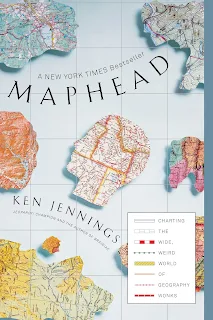
Maphead - Charting the Wide, Weird World of Geography Wonks by Ken Jennings book cover

Maps are such a big part of our lives, I'm surprised I haven't read into the topic before now. I'm old enough to remember planning a journey with a road atlas or referring to handwritten directions, but I look at maps far more often now with GPS and Google Maps than I ever did before. In Maphead - Charting the Wide, Weird World of Geography Wonks, Ken Jennings is the ultimate tour guide.

Early on, he starts with some basics about different kinds of maps, like this one:
"Hypsometric maps are those ones that represent terrain with vivid colours: greens for low elevations, browns and purples for high ones. 
I preferred the clean political maps that Hammond and National Geographic published, where cities and towns stood out neatly on lightly shaded territory and borders were delineated in crisp pastels. In fact, I dislike hypsometric maps to this day." Page 6
I wasn't a fan of hypsometric maps when I was in Defence standing in the bush with a compass in my hand, but I do love an informative choropleth map, especially during elections:
"'Choropleth' maps - those in which areas are colored differently to represent different values on some scale, like the red-and-blue maps on election night - date back only to 1826." Page 8
Jennings is the knowledgeable navigator in the passenger seat on this journey, and as you drive through the pages and chapters, he readily provides all manner of info about geonerds and their love of maps. If you enjoy learning quirky facts in quick succession, this is for you. Example, did you know that 'cartacacoethes' is the uncontrollable compulsion to see maps everywhere?
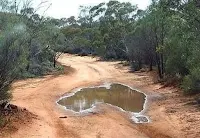
Puddle in the shape of map of Australia

The puddle that looks like a perfect map of Australia immediately springs to mind, as does my remark last night that the protein (pork schnitzel) looked like the shape of Africa.

When the allies were planning the 1944 invasion at Normandy, there were extraordinary contributions made my mapmakers who had stolen across the English Channel by night for many months to map the coastline. Furthermore:
"In 1942, the BBC asked its listeners to send in prewar postcards and holiday snaps from the beaches of Europe. Seven million poured in, showing coastlines from Norway to the Pyrenees, and they were used to select Normandy as the site of the initial landing." Page 59
Despite a reasonable knowledge of military history, this was completely new to me. It seems unheard of, until you remember a similar call out by more recent governments: 'if you see something say something' and the images submitted post 9/11.

I was happy to see Humpty Doo (Northern Territory) get a mention in the section about place names and toponymists, as the author tells us he's been an enthusisastic toponymist - a student of place-names - for as long as he's loved maps. We then move on to the market for collectors of ancient maps and globes for display purposes that stretches as far back as the Renaissance:
"This was a watershed moment in the history of cartophilia. For thousands of years, people had drawn maps because they had to: to get from one place to another, or locate taxpayers, or mark the boundaries of fields and pastures. If not for those maps, lives or property would be lost, governments might fall. But here, for the first time, we have evidence of people keeping maps just because they liked looking at them." Page 99
Here Jennings mentions several figures from history - like John Dee, Samuel Pepys - who loved collecting and viewing maps, including Vermeer who reproduced maps in the backgrounds of more than a quarter of his paintings.

For readers who would rather leave history in the past, the section on maps in fantasy fiction was illuminating. C.S. Lewis, Tolkien, David Eddings are mentioned, but it was the detail about Brandon Sanderson's maps that held my attention the longest. The author and Sanderson were college roommates, so he offers quite an insight.
"The hallmark of epic fantasy is immersion," says the best-selling genre writer Brandon Sanderson. "That's why I've always included maps in my books. I believe the map prepares your mind to experience the wonder, to say, 'I am going to a new place.'" Page 113
Jennings weighs in on the 'map gap' between the genders, and he made some convincing arguments:
"Tests on gender and navigation have found that women tend to navigate via landmarks ("I turn left when I get to the gas station") whereas men use dead reckoning ("I still need to be north and maybe a little west of here"), which ties in nicely with the evolutionary perspective: early men went out on hunting expeditions in all directions and always needed to be good at finding their way back to the cave, developing their "kinesic memory," while women foraged for edibles closer to home, developing "object location memory." Simply put, men got better at finding places, while women got better at finding things." Page 139-140
I'm also guilty of setting my map preference to 'forward is up', while my husband prefers the 'north is up' orientation which totally messes with my mind when I'm forced to use it.

The section on systematic travel was fascinating, and the first person who came to mind was Matt Harding, whose Where the Hell is Matt? series went viral in the 2000s. Some systematic travellers aim to visit every country in the world, perhaps every capital city, every state in the USA, the most northern/southern/eastern/western tip of a landmass. But how about ticking off the junction of state borders, or the highest mountains on every continent? The sky is the limit, and while I think I'd find the concept stressful, ticking off locations is high on the list for systematic travellers.

Just like twitchers and trainspotters, roadgeeks are the highway scholars of mapheads, and take photos of road signs to clock their routes.
"They can tell the difference between a Westinghouse streetlight and a GE one and are the only ones who notice when the lettering on interstate signage is switched over from Highway Gothic to the new Clearview font." Page 167
I don't know why, but I find this incredibly reassuring and even comforting. Perhaps knowing there are people in the world who pursue these particular interests gives me a sense that in every field, no matter how specialised, there is an expert; someone who lives and breathes everything there is to know about that topic.

The chapter on geocaching had me checking for geocache locations near me and - just like the author - I was surprised to find one less than 500m from my front door! It only required a photograph to complete the find, so I wasn't tempted to sign up and start checking caches on the weekend, but I'll certainly look twice next time I see someone taking a selfie at that location. They could be a geocacher!

Maphead by Ken Jennings is endlessly fascinating, and while I've been lucky enough to experience the thrill of watching the numbers tick over on the GPS when crossing the equator, did you know that confluence hunting is a thing?
"The Degree Confluence Project was started in 1996 by a Massachusetts Web programmer named Alex Jarrett, a new GPS owner who noticed that his commute happened to take him across the nearby seventy-second meridian twice a day." Page 237
Jennings tells us that no spot on Earth is more than 49 miles from one of these points of 'cartographic perfection' and there are 16,340 confluence points worldwide. Can you imagine? Maybe you've been lucky enough to visit a location (US has a few) where you can stand right at the spot where 3 or 4 states come together. Perhaps you just give a hoot when you cross from NSW to VIC in your car, but for a confluence hunter this is small fry.

I can see this review is getting long, and I haven't even begun to touch on all of the Google Earth and street view stuff! In reading Maphead and learning why so many people are cartographically cloddish, I'm convinced Geography needs to re-enter the curriculum of the day. 

If you suspect you'll need to look up images of maps while reading this, you're spot on, so have your device at the ready. Maphead - Charting the Wide, Weird World of Geography Wonks by Ken Jennings is an absolutely fascinating read and I'll be sorry to return it to the library. 

Highly recommended!

My Rating:


23 February 2023

Review: The Ten Thousand Doors of January by Alix E. Harrow

The Ten Thousand Doors of January by Alix E. Harrow book cover

The Ten Thousand Doors of January by Alix E. Harrow is a young adult urban fantasy novel about adventure, stories, portals, travel and change. I knew I was going to be in safe hands very early on when our narrator quotes her father on Page 2:
"If we address stories as archaeological sites, and dust through their layers with meticulous care, we find at some level there is always a doorway. A dividing point between here and there, us and them, mundane and magical. It is at the moments when the doors open, when things flow between worlds, that stories happen." Page 2
And that's precisely what happens here. Our narrator is young January Scaller and her life changes forever when she finds a door at the age of seven. January is a difficult child with an absent father, and was given a number of nursemaids, who soon quit their position. Here's a robust character description of a new nursemaid from our narrator:
"The newest one [nursemaid] was a German immigrant named Miss Wilda, who wore heavy black woolen gowns and an expression that said she hadn't seen much of the twentieth century yet but heartily disapproved of it thus far. She liked hymns and freshly folded laundry, and detested fuss, mess, and cheek. We were natural enemies." Page 16-17
Don't you just love that? I can picture Miss Wilda perfectly, and even more, I want to read about all the ways they disagreed. Growing up as the ward of Mr William Cornelius Locke - a self-made almost-billionaire and chairman of the New England Archaeological Society - January lives in a mansion full of antiques and rare collectibles, yet is restless. She doesn't interact with anyone her own age, with the occasional exception of Sam, the son of the local grocer.
"I used my most grown-up voice, as if I had never once chased him across the lawn howling for his surrender or fed him magic potions made of pine needles and lake water." Page 33
This is an historical fiction adventure story, and like many great adventure stories before it, there's a book and on finding it, the reader - along with January - is plunged into the story of young Adelaide:
"Standing beside her grandmother's deathbed, woolen dress still smelling of black logwood dye, Ade had felt the way a sapling might as it watched one of the old forest giants come crashing magnificently to rest: awed, and perhaps a little frightened. But when Mama Larson's final breath rattled from her ribs, Ade discovered the same thing the young sapling would have: in the absence of the old tree, there was a hole in the canopy above her." Pages 97-98
Early on it was difficult to separate the stories of Ade (Adelaide) and January in my mind, and the third person narration was briefly confusing, but thankfully it improved as the novel progressed. Harrow's exquisite writing more than compensated for the flow, and I marvelled at her ability to convey so much in just one sentence:
"She took another gulp from the brown glass bottle and muttered herself into silence, complaining about rich folk, young folk, nosy folk, Yankees, and foreigners." Page 338
The Ten Thousand Doors of January reminded me of Strange the Dreamer by Laini Taylor a little, in the shared coming of age quest of sorts that leads to danger, adventure and eventually self discovery. The existence of portals that lead to other worlds isn't new in fiction, and I've enjoyed The Chronicles of Narnia by CS Lewis, The Starless Sea by Erin Morgenstern and more recently Fairy Tale by Stephen King.

In this particular portal fantasy novel, the doors represent change and characters very quickly decide whether that change is good or not. The doors create an inevitable 'leakage between worlds' (the author's words, not mine) which includes people and objects travelling between them. My mind was racing at this point, imagining how this theory could apply to some of the mysteries in our own world as we know it. Perhaps the Voynich manuscript came from one of these worlds, who knows?

Naturally, this gives rise to themes of ethnicity and multiculturalism, as does the idea of preserving each world in its current state and slowing or preventing the use of doorways to freely travel. Younger readers will take this at face value, while mature readers will see how these attitudes and prejudices are reflected in our history and in our present.

I'll leave you with one last quote I hope you might like:
"Those of you who are more than casually familiar with books - those of you who spend your free afternoons in fusty bookshops, who offer furtive, kindly strokes along the spines of familiar titles - understand that page riffling is an essential element in the process of introducing oneself to a new book. .. It might smell expensive and well bound, or it might smell of tissue-thin paper and blurred two-color prints, or of fifty years unread in the home of a tobacco-smoking old man. Books can smell of cheap thrills or painstaking scholarship, of literary weight or unsolved mysteries. 
This one smelled unlike any book I'd ever held. Cinnamon and coal smoke, catacombs and loam. Damp seaside evenings and sweat-slick noontimes beneath palm fronds. It smelled as if it had been in the mail for longer than any one parcel could be, circling the world for years and accumulating layers of smells like a tramp wearing too many clothes." Pages 22-23
I just love that quote! I recently learned that bildungsroman is a term used to describe a coming of age story; thanks to Sam for that little pearl. This book was a gift for Christmas and The Ten Thousand Doors of January by Alix E. Harrow is a bildungsroman for those who prefer their reading material to be full of adventure and fantasy with a touch of historical fiction. 

Highly recommended. 

My Rating:


17 December 2022

Review: Dark Skies by Lonely Planet

I've always loved stargazing, and Dark Skies - A Practical Guide to Astrotourism by Valerie Stimac and Lonely Planet was given to me by my husband for Christmas in 2020. Given some of the celestial events have dates attached (lunar and solar eclipses for example), I thought I'd better read this before another Christmas passes me by and it's still on the shelf.

Dark Skies is very much a Lonely Planet guide to astrotourism; a new term for me.
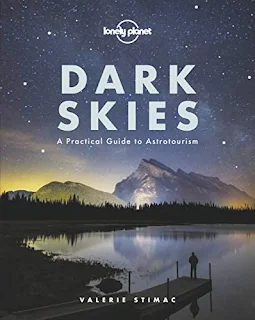
Dark Skies - A Practical Guide to Astrotourism by Valerie Stimac and Lonely Planet book cover

It's broken down into the following chapters:
Stargazing
Dark Places
Astronomy in Action
Meteor Showers
Aurora
Eclipses
Launches
Space Tourism

I was most interested in the Dark Places, Meteor Showers and Eclipses chapters, but they're all very interesting and comprehensive given what's on offer.

Another new-to-me word is archaeoastronomy and I enjoyed learning about it in the chapter on Dark Places:
"Archaeoastronomy, the so-called 'science of stars and stones,' is the interdisciplinary study of how ancient cultures used the night sky as part of culture and society - including in construction. Sites like Stonehenge in England and Chichen Itza in Mexico are among the locations of interest to archaeoastronomers, since they seem to be aligned with celestial events such as equinoxes and solstices. Archaeoastronomers use material remains to examine how ancient cultures related to phenomena in the sky." Page 95
What a fascinating area of science!

It was also interesting to read that the next total solar eclipse visible from Australia and New Zealand takes place on 22 July 2028, with Sydney being in the path of totality. The entire eclipse will take 2.5 hours and totality in Sydney will last a maximum of 3 minutes and 58 seconds. To enjoy the maximum 5 minutes and 10 seconds, enthusiasts will need to travel to rural Australia.

Light pollution - and seeking locations free of it - was a continual theme in Dark Skies, and that's to be expected. I also noticed an optimism that an increase in astrotourism will inevitably result in a greater appreciation and respect for the environment and a subsequent shift in thinking towards how we treat the planet. There's much we can do to reduce night time light pollution (for which our native habitats will be grateful), and I enjoyed that the book closed with:
"If astrotourism helps more people protect our amazing home planet, the future will be bright.... and the night skies will be dark and full of stars." Page 283
It definitely reminded me of the alternate phrase from Game of Thrones, "The night is dark and full of terrors."

Dark Skies very much feels like a Lonely Planet guide, and while I've only read two (Kenya and Hawaii) this was a familiar format. As in those two books, you need to break up the reading of a Lonely Planet guide within your regular reading schedule. Some of the content is dry and after a while, the consistent format can become repetitive and dull. Thankfully some amazing photographs remind the reader of the power and wonder of the night sky and the universe beyond.

Dark Skies is a valuable resource that will quickly date; as with all Lonely Planet books.

My Rating:


15 July 2022

Giveaway (5 copies) & Review of Once Upon A Camino by Matthew S. Wilson

* Copy courtesy of the author *
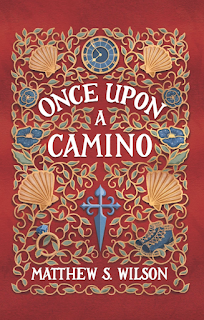
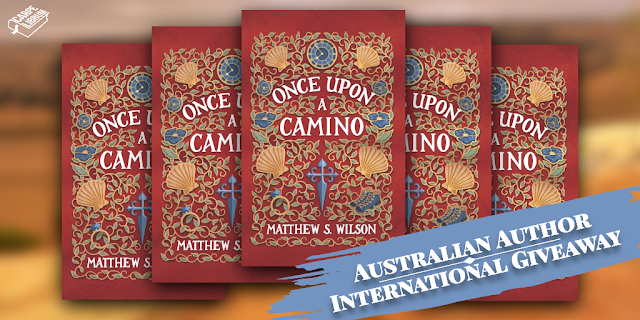
Once Upon A Camino by Matthew S. Wilson book cover

Nine years ago, I interviewed Melbourne based author Matthew S. Wilson about reading, writing and his debut novel at the time, The Devil's In The Detail. Since then, Matthew has been working hard on his next masterpiece and has re-emerged from years of research with a compelling adventure story set in Spain.

Today marks the release of Once Upon A Camino by Matthew S. Wilson and to celebrate, Carpe Librum is giving away 5 copies signed by the author. This is an international giveaway and entries close at midnight AEST Sunday 24 July. See below to enter. 

Review

So, what did I make of it? I enjoyed it! Once Upon A Camino is about Tom and his journey on foot as a pilgrim along the Camino de Santiago in Spain. Tom is a successful white collar worker in London in love with his girlfriend Ana. He decides to fly to Spain in order to ask for her family's blessing to marry, but Ana's grandfather wants him to prove his love for her. What happens next is an unexpected series of events as Tom agrees to walk the Camino so he can propose to Ana.

Along the gruelling journey, Tom meets fellow pilgrims and they share their stories and motivations for making the same trek. The setting reminded me a little of a modern day take on The Canterbury Tales by Geoffrey Chaucer (there's even a Knight!) and I really enjoyed it.

Inspired by his own trek along the Camino in 2010, Once Upon A Camino is thoroughly researched and gave me an insight into Spanish history I hadn't encountered before. Unfolding from multiple character points of view and comprising an element of historical fiction, Once Upon A Camino is a story about love, courage, friendship, regret, fate and destiny and was beautifully told.

My Rating:

Blurb

Tom, a 28-year-old investment banker, lives a successful life in London with his girlfriend, Ana. Intending to propose, he flies to Spain, seeking her family’s blessing. But his plan runs aground when Ana’s grandfather, Tito, insists the union cannot proceed until Tom walks the Camino de Santiago, an 800-kilometre pilgrimage across Spain.

‘A man would walk across a country without hesitation for the love of his life, no?’

Upon commencing the Camino, Tom’s plans further unravel – his backpack mysteriously disappears, and his phone loses its signal. And when all the other hikers seemingly vanish, Tom makes a discovery that changes everything. Suddenly pursued by the authorities, Tom’s only path home to Ana is alongside a motley band of pilgrims bound for Santiago – among them a reclusive fisherman named Fernando, who carries his own dark secret.

Once Upon a Camino is a novel about time. It focuses on past regrets and untrodden paths. It’s a story of friendship and connection, of following your heart, despite your better judgement. It’s written for those who’ve walked the path to Santiago and others who simply enjoy life’s unpredictable journey and the strangers we meet along the way.
Carpe Librum image promoting giveaway of 5 signed copies of Once Upon A Camino by Matthew S. Wilson

Giveaway

This giveaway has now closed and the winners have been announced.